Wednesday, August 16, 2006

Ashes Countdown 99

The first test series that was played between Australia and England in 1882-83, after the 1882 England’s debacle and the The Sporting Life’s obituary which gave birth to the Ashes legend, basically was a contest for the imaginary Ashes. The English fourth estate referred the three test matches tour by England as “ the quest to regain Ashes of English Cricket”. England was led by Hon. Ivo Bligh , who later became Lord Darnley.

Australia, captained by Billy Murdoch, won the 1st test at Melbourne very easily by 9 wickets after enforcing a follow on. England came back with vengeance and won the next test at the same venue by an Innings and 27 runs. England’s Willie Bates putting up an excellent all-round perfromance by making a half century (55) and then claiming 7 wickets in each of Austalia’s two innings including a Hat-trick in the 1st. In the 3rd test of the series played at Sydney, after being set an easy target of 153 runs for victory Australia collapsed to Richard Barlow’s medium pace bowling for 83 there by losing the test by 69 runs. Barlow took 7 for 40. Thus England registered a series victory and regained the imaginary Ashes. That’s exactly where the story of Ashes Urn began.

The English captain, Ivo Bligh, who stayed at the home of one Mr. Fletcher’s family was presented with a velvet bag by Anne Fletcher to keep the imaginary Ashes. Bligh later met some victorian ladies who included his future wife Florence Morphy . They thought the velvet bag alone was not an award enough for the England’s victory over Aussies. Florence and her friends burnt either a bail or a stump and kept the ashes in a silver urn and presented it to Bligh. Bligh handed over the souvneir to the cricketing authorities at Lord’s to be seen by other members. They later returned the urn & the velvet bag back to Bligh. The urn which was supposed to have been kept in the velvet bag remained with Bligh and Florence who got married during Bligh’s next trip to Australia.

No one knew the wherabouts of the urn till 1927, when it resurfaced again with Florence presenting it to MCC after the death of her husband as per his will. The urn and the velvet bag are ever since kept under the safeguard of MCC permanetly in the Long Room at Lord’s in a display cabinet.

The original Ashes urn was never really handed over to the winning captain and did not move from its display since 1927, except for a brief period during 1988 to be displayed in Australia as part of it’s bicentennial celebrations. So with all the hype that is surrounding Ashes, Australia and England have in fact been fighting hard for an imaginary and virtual trophy for more than 124 years.

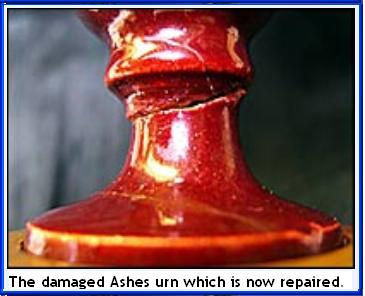
As weird as it may sound the goblet shaped 4-inch (10 cm) high urn which was supposed to have made its second appearance in Australia during the Ashes tour of 2002/03 was dropped from the squad at the the last mintue because of an injury to its stem between the main body and the foot. X-Rays revealed that there was a 75 year old crack in that area and as per the advice by the experts there was a real risk of the urn breaking down in that condition when subjected to unnecessary movement and changes in humidity and pressure.

The repair work was carried out by Plowden and Smith Ltd as number of cracks on this most valuable cricketing artifact were fixed with surgical precision. Now the urn is all set to tour Australia during the coming Ashes tour. The urn along with its sibling Velvet bag will be displayed in all five major test cricket centers Sydney, Brisbane, Adelaide, Perth and Melbourne as part of an Ashes exhibition.
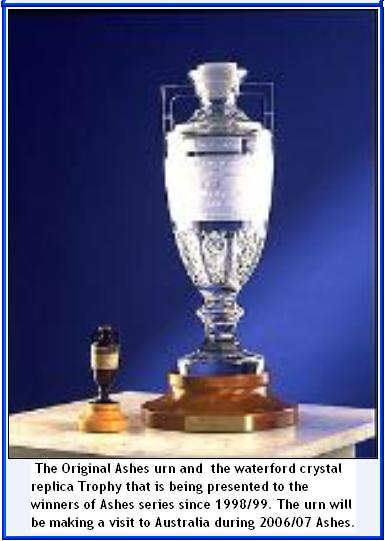
Though every test series that were played between Australia and England were cricketing battles to hold the Ashes Urn, no trophy was ever awarded to the winner of the series. Only since 1998/99 Ashes series a Waterford crystal trophy, a much bigger replica of the Ashes urn is being awarded to winner of each of the Ashes test series. England won their first trophy last year when they beat Australia by 2-0 margin in one of the most closely contested and extremely entertaining test series of all-time.

If England keeps the original urn which was bequeathed to MCC by Hon. Ivo Bligh permanently with them Australia does have their own precious 24cm replica which was presented to Bradman after his last test series in England which he led them to a 4-0 series win, though he was out for that famous duck in his final innings he did carry back the Ashes urn replica which is currently showcased in Australian Cricket Board’s offices in Jolimont, Melbourne.

Ashes Countdown Factoid 99:

None of the series played before the 1882/83 were considered as Ashes Tests. This includes the 1882 Test at The Oval which started the legend of Ashes. This could be because the Ashes term came in to vogue only after the test match was played and was lost by England in that manner.

A fourth test match was arranged and played at Sydney after England regained the imaginary Ashes by winning the 1882/83 test series which brought the Ashes urn in to its existence. This test may have been arranged to field a much stronger Australian side to beat England which they eventually did by 4 wickets.

The centenary test played at Melbourne during 1976/77 tour which produced exactly the same result as the first ever test match played at the same venue in 1876/77 (A victory for Australia by 45 runs) is not considered as an Ashes Test so is the centenary test played at Lord’s in England in 1980. Also the 1987-88 Sydney test which was played as part of Australia’s Bi-centenary celebrations is not considered as an Ashes Test.

The only test series during which England played 3 or more tests but still not considered as Ashes series was the 1979-80 test series when Australia played both England and West Indies in tandem. England agreed to play that series as part of a deal between ACB and Kerry Packer to end the World Series Cricket under the condition that those tests did not have Ashes status. After all they were holding the Ashes which they won the previous season by beating a very weak Australian side by 5-1 margin and did not want to take the risk of handing it back as the Australian team now included the likes of Chappell brothers, Rodney Marsh, Doug Walters and the terror twins Lillee & Thomson were expected to thrash England in a clean sweep. Their fears were found true as England lost that series by 3-0 margin.

Tuesday, August 15, 2006

Ashes Countdown 100


Its exactly 100 days from today England and Australia would be starting their quest for the Ashes. England tries to keep the urn which they deservedly won last year and Australia which had kept it for 16 years, will attempt to regain it back. Number 16 seems to be an unlucky one for Australia as they lost that famous Laxman’s Test to India after winning 16 tests in a row. Anyway that is beside the point.

Earlier in the morning at Sydney Harbor Michael Clarke & Brett Lee cut a cake shaped in the form of the Ashes Urn to mark the countdown.

Starting today I would like to present some interesting facts about the Ashes during the next hundred days (not every day) leading upto the first day of the first test to keep myself occupied,excited and prepared for the big event that’s going to start at Brisbane on Nov 23rd 2006. Here we go:

Ashes Countdown Factoid 100:

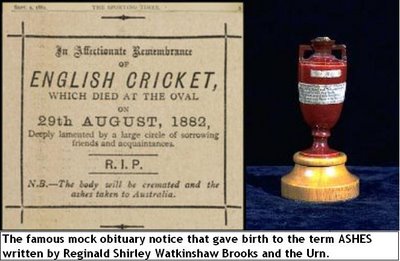
It’s a well known fact that The Sporting Times has published the following mock obituary on September 2nd 1882 which led to the creation of the term Ashes for the series between Australia and England ever since.

"In Affectionate Remembrance of ENGLISH CRICKET, which died at the Oval on 29th AUGUST, 1882, Deeply lamented by a large circle of sorrowing friends and acquaintances R.I.P.
N.B. — The body will be cremated and the ashes taken to Australia."


Here are some of the lesser know facts.

Not many people know who wrote that : His name is Reginald Brooks.

Similarily not many people know there was similar mock obituary which was published couple of days earlier in the 31st August edition of a Cricket magazine “Cricket: A Weekly Record of The Game” Which read “English Supremacy in the Cricket Field which expired on the 29th day of August at the Oval”. I doubt if this too, in addition to the 7 run loss that England suffered while chasing a paltry 85 run target, has had any influence on the young London Journalist “Reginald Shirley Watkinshaw Brooks” to come up with the now immortalised Ashes obituary notice.

The poem that appears on the urn which is believed to contain the the ashes of the burnt bails or stumps or may be none of them reads as follows:

When Ivo goes back with the urn, the urn;
Studds, Steel, Read and Tylecote return, return;
The welkin will ring loud,
The great crowd will feel proud,
Seeing Barlow and Bates with the urn, the urn;
And the rest coming home with the urn.

We can only assume that the poem, which was presented to Bligh along with the urn, may very well have been written by Florence, wife of Hon. Ivo Bligh's who lead the 1882-83 English team that toured Australia.

Friday, August 11, 2006

Test Records - Week Ending 6th August 2006

As it is becoming increasingly time consuming to insert tables with hyperlinks from my spreadsheets onto this blogger, I have alternatively having my blog posted at http://vjeedigunta.sulekha.com and http://cricketstats.rediffiland.com.

Please visit those sites for the tables/lists with hyperlinks to the players/test matches. However, I will be having a static picture of the tables for your referece to the stats.

Test # 1812 South Africa in Sri Lanka 2006 (2nd Test) at P Saravanamuttu Stadium, Colombo


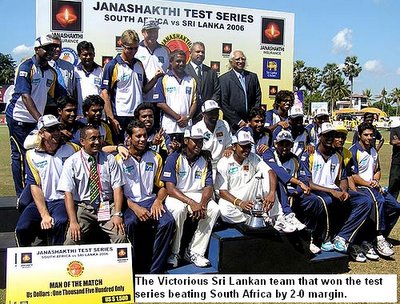
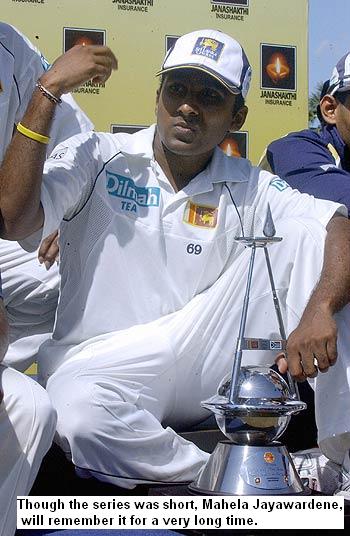
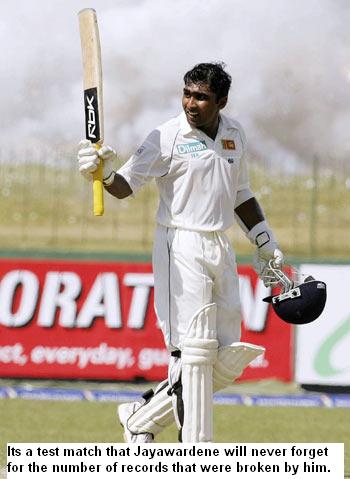
Rarely in Test History a short 2-test series will produce so many records as the series between Sri Lanka and SA did. The second test too lived up to the expectations of all cricketing buffs who were anticipating more excitement in the series after the records-setting first test. With a masterly knock of 129 following his marathon innings of 374, Jayawardene not only took his aggregate past 500 mark but also helped Sri Lanka register a 2-0 series victory. In the end the test match proved out to be a real thriller and provided all the excitement, drama and suspense of an Hitchcock movie to everyone who watched it except for a former Aussie batsman and commentator Dean Jones for obvious reasons.
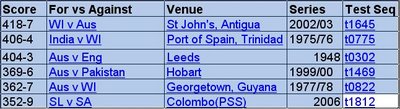
The test match could have produced all the four results and it’s a tribute to Sri Lanka that they won the test match at the end without choking like they did against the same rivals at Asgiriya stadium , Kandy in 2000 (t1505) when they fell short by 8 runs chasing a modest victory target of 176 and were 161 for 6 before losing their last 4 wickets for 8 runs.

Four years later at the same venue in 2004 (t1688) playing against Australia, Sri Lanka was chasing exactly the same score of 352 as in this test. They were crusing along comfortably at 319 for 7 at one stage needing just 33 more runs for victory. Sri Lanka started the final day at 301 for 7 and were inching towards victory with their 8th wicket pair Vaas(30*) & Lokuarachchi(13*). They needed to score just 51 more runs on the final day and were doing well to take the score to 318 for 7 before a sudden rush of blood made Chaminda Vaas threw his wicket away by trying to slog sweep a Warne’s delivery and was out getting caught in the deep. That triggered a Sri Lankan collapse as they lost their last 3 wickets for 5 runs and fell short of the target by just 11 runs.

Memories of those two test matches may have been lingering through the minds of five members of the current Sri Lankan squad ( Jayasuriya, Sangakkara, Mahela Jayawardene Vaas & Muralitharan) who were part of those two losses, when Malinga joined Maharoof with Sri Lanka needing just two runs. But Maharoof and Malinga took a single each to register a dramatic win for Sri Lanka and in this case made sure that history does not repeat itself and they no more a bunch of chokers who would wilter under pressue.

Here are the some statistical highlights of this test:

Sri Lanka’s 352 run chase for a victory is sixth highest in test cricket.
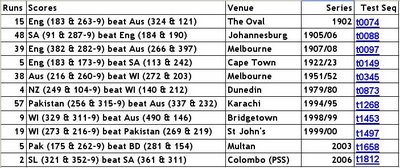
Sri Lanka’s One wicket win is 11th such instance in test cricket and their victory target is highest among these victories.
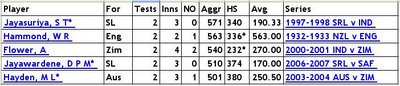
Jayawardene aggregated 500+ runs in this two-test series and joined another four cricketers who did the same in test history. Following is the table of all such instances.

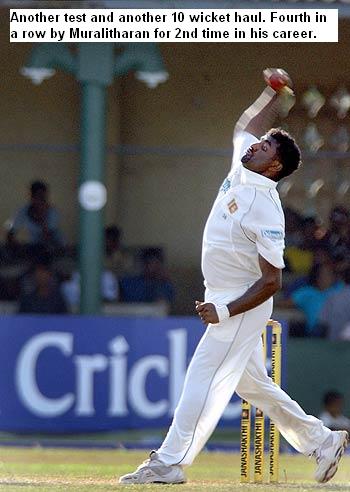
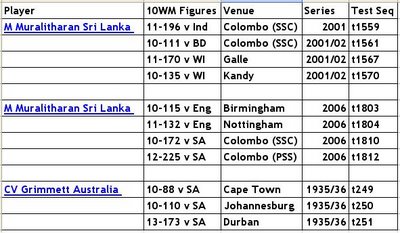
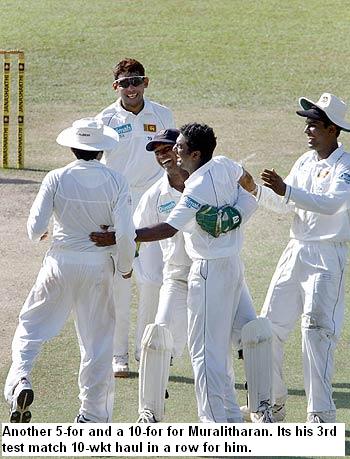
Muralitharan registered another 10-wicket haul, a record 18th time in a test career, thus making it 4-in-row (t1803,t1804,t1810 & t1812). This is the second time that he achieved this remarakable feat having done so earlier in 2001(t1559,t1561,t1567 & t1570). No other bowler could achieve this feat even once. Only bowler who came anywhere near this record was Australia’s Clarrie Grimmet , who in 1935/36 series against SA (t249,t250 & t251) took 10 wickets in each of the 3rd,4th & 5th tests. His feat though was unique in its own way as he is the only bowler in test history to have taken 10 wickets in a test 3 times in the same series. Muralitharan’s with his twin 5-wkt hauls in this match 5 for 128 in 1st innings and 7 for 97 in the 2nd has also extended his 5 wicket in an innings of test match record to 56. Muralitharan at the end of this series has taken his career tally to 657 wickets from 108 tests at an average of 21.89 at phenomenal strike rate of 6.08 wickets per test. He is now just 28 wickets short of Shane Warne's record. Warne has 685 wickets from 140 tests at an average of 25.25 and a strike rate of 4.90. Just for those who are stistically minded like me. Warne has taken 134 tests to take 657 wickets. In 9 tests that Murali played this year he has taken 73 wickets with eight 5-wkt hauls in an innings and seven 10-wkt hauls in match. That is truly amazing.

Following is the list of Murali’s and Grimmett’s 3+ consecutive 10 wicket hauls:


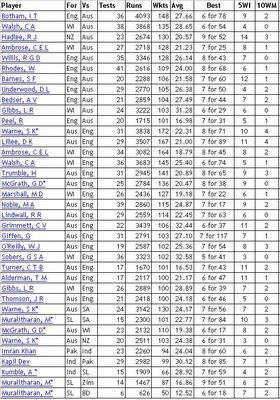
Muralitharan also claimed his 100th test wicket against SA and became only the 2nd bowler in test history after Shane Warne to have claimed 100+ wickets against springboks. In all, there are 32 instances of a bowler claiming 100+ wickets of the same opponent. 11 of them took 100+ wickets against Aus, 17 against Eng, 2 against SA, 1 each against WI & NZ. Kapil Dev missed to become a part of this club by a whisker. His 99 wickets against Pak is highest against that country. Kapil’s counterpart Imran Khan holds the record for most number of wickets against India.with 94 wickets. Anil Kumble with 66 against Sri Lanka and Muralitharan with 87 against Zimbabwe and 50 against Bangladesh holds the records agsinst those countries.

Following is the table of all 100+ wicket-takers against a specific country:

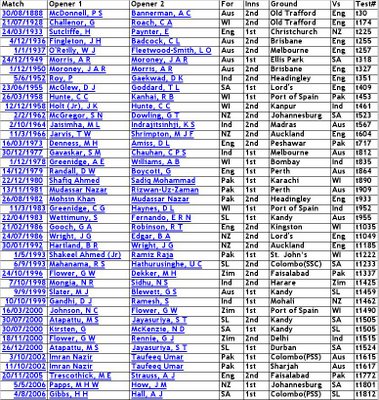
South Africa too had their share of test records in this test. They provided the 102nd instance of amassing 350+ runs on the first day of a test match. (refer to my earlier posting on this). But in a stark contrast to such a good batting display in first innings , they lost both their openers for a duck in the 2nd innings thus providing 42nd occasion of a team losing both their opening batsmen for a duck in an innings.

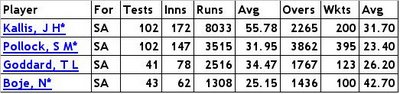
Nicky Boje who had a torrid time in his previous test when his bowling went for a leatherhunt, picked up his 100th test wicket in this test in the form of Mahela Jayawardane. He thus becomes 139th player and 10th from South Africa to take 100 or more wickets in a test career.Having already completed his 1000 test runs , he also becomes the 4th springbok to join the 1000runs+100wkts all roudners club as its 47th member.

In Sri Lanka’s first innings when Mark Boucher caught Chaminda Vaas off the bowling of Steyn he became only the 2nd Wicket Keeper in test cricket to have taken 350 catches behind the wicket. Boucher’s tally includes 2 catches he had taken while playing for ICC XI against Australia.

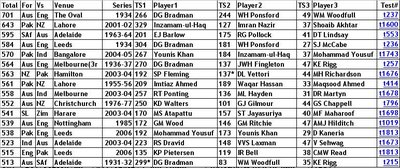
Another rare occurrence that happened in this test match was that in all four innings of the match 300 or more runs were scored. This in fact is only 13th such instance 8th in a test match that produced a result.


Test #1813 England in Pakistan 2006(3rd Test) at Headingley, Leeds


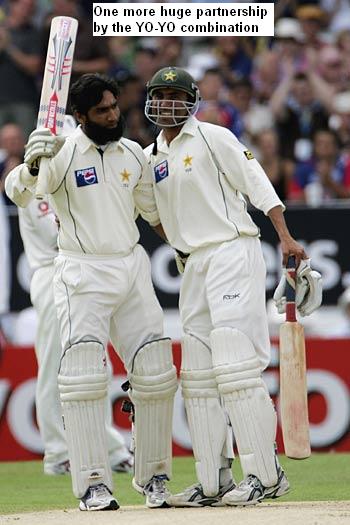
This test match which followed the same course till the final day with Pakistan needing 323 runs for a victory with all their wickets in hand, kind of finished with an anti-climax as Pakistan was bundled out for 155 runs thereby leaving England winners by a huge margin of 167 runs. The Yo-Yo combination (Younis Khan with 173 & Mohammad Yousuf with 192) again produced a huge partnership of 363 runs, but this time in a losing cause. Though their partnership did not help in a victory for Pakistan, it did break a an 81yr old record of 283 run opening stand between Jack Hobbs & Herbert Sutcliffe against Australia in 1924/25 at Melobourne as the highest partnership for any wicket by a losing side.

The 3rd wicket partnership of 363 runs between Younis and Yousuf also set a new partnership record by Pakistan for any wicket against England when they touched the 323 run mark eclipsing the previous best between Javed Miandad and Salim Malik who added 322 at Edgbaston in 1992. When the partnership touched the 339 run mark it became best third-wicket partnership against England, surpassing the previous best of 338 between Everton Weekes and Frank Worrell at Port-of-Spain in 1953-54
With their partnership pakistan amassed 538 runs though no other Pakistani was able to score 30 runs with Danish Kaneria recording the 3rd highest score of 29. Surprisingly this is not a lowest 3rd highest score in a test match innings of 500+ runs. That record still belongs to the 1934 Leeds test in which Australia scored 584 runs in their 1st innings with Bradman making 304 & Ponsford 181 and the next highest score of 27 was being that of Stan McCabe. Following table lists all the test match innings totals of 500 or more in which there were just two 50+ scores. It includes England’s 1st innings too as their 515 total had just two scores of 50+, 135 by Kevin Pietersen and 119 by Ian Bell. This is the one and only such test match occurrence in which both sides scored 500 or more runs with each side having just two 50+ scores.


Both sides making scores of over 500 runs too is a rarity in test cricket.This test match provides 23rd such occasion. This is only the 2nd of those tests which produced a result. Following is the list of all such instances:

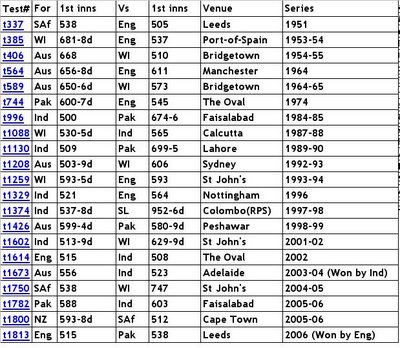
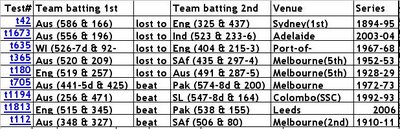
Pakistan's loss also provides only the 9th instance of a side making 500+ runs in their 1st innings and still went on to lose the test match. Side batting first is listed first in the table from the left.
Finally some trivia facts:


By getting out with not so common type of dismissals in both the innings , hit wiciket in 1st and stumped in 2nd , Inzamam-ul-Haq becomes only the 2nd cricketer in history to have got out in both the innings of a test match as stumped and hit wicket. Robert Peel of England was the other batsman to have suffered this fate against Australia at Sydney in 1887-88.


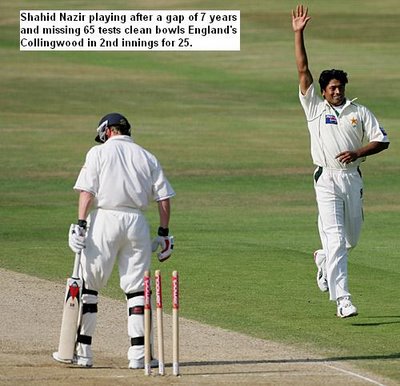
Shahid Nazir of Pakistan made a comeback to test cricket after being in oblivion for more than 7 years and missing 65 tests.The record for missing for most number of tests by a cricketer between two test appearances belongs to Mark Bicknell of England who missed 114 tests from 1993 to 2003.

Danish Kaneria with his 1st innings knock of 29 is fast closing the gap between the number of wickets he has taken in test cricket (167) and the number of runs he made (160).

Tuesday, August 01, 2006

Test Records - Week Ending 30th July 2006

Test # 1810 Sri Lanka vs South Africa (1st Test) at Sinhalese Sports Club (SSC) Colombo.

It’s very ironic that Mahela Jayawardane made his test debut when Sri Lanka plundered 952 runs to record the highest total in test cricket. In his wildest of dreams Jayawardane would never have imagined that one day he would surpass Sri Lanka’s highest individual innings score of 340 by Jayasuriya. What about that unbelievable partnership of 576 between Jayasuriya and Mahanama? He may not have even given a thought to it as it needed another player who could stay with him for long and score enough. But test cricket has long history of repeating and seldom overtaking unbreakable records.

Consider this…

Sobers’ highest individual score of 365* was not touched for 36 yrs and now it is pushed back to 5th place.

Laker’s 10 wickets in an innings is another such record which was considered as untouchable and remained so for a very long time… but then Anil Kumble thought otherwise…

What about Bradman & Ponsford’s 451 run partnership which was set in 1934 stood as highest in test cricket for more than 56yrs? Though it was touched by Mudassar Nazar and Javed Miandad in 1982/83 it was only overtaken by Andrew Jones and Martin Crowe 8 years later when they notched up a 467 run partnership against SL in 1990/91.
Within 8yrs that record too was obliterated and was taken to a new territory of 500 when Mahanama & Jayasuriya set that 576 run partnership record. Jayawardane was a mere 20 yr old test debutant and looking to make his mark in a star-studded Sri Lankan batting line-up. He did make an impressive debut though with a polished 66 in a 141 run partnership with Jayasuriya who went on to record Sri Lanka’s 1st and only triple century.

Now that too is history…

Jayawardane and Sangakkara took the partnership record to a whole new territory of 600 run mark. Their 624 run partnership is not only the highest in test cricket but also has overtaken the 60 yr old record in first class cricket. The previous record holders Vijay Hazare and Gul Mohammad added 577 for the fourth wicket in 1946/47 Ranji Trophy final to help Baroda defeat Holkar.


Wkt


Runs


Batsmen


Ground


Match


1st


413


M H Mankad and P Roy (Ind)


Madras

1955-1956 v. NZ


2nd


576

S T Jayasuriya and R S Mahanama (SL)

Colombo(PSS)

1997-1998 v. Ind


3rd


624

D P M Jayawardene and K C Sangakarra (SL)

Colombo(SSC)

2006-2007 v. SA

4th

411

P B H May and M C Cowdrey (Eng)

Birmingham

1957 v. WI

5th

405

S G Barnes and D G Bradman (Aus)

Sydney

1946-1947 v. Eng

6th

346

J H Fingleton and D G Bradman (Aus)

Melbourne

1936-1937 v. Eng


7th


347


D S E Atkinson and C Depeiza (WI)


Bridgetown

1954-1955 v. Aus


8th


313

Wasim Akram and Saqlain Mushtaq (Pak)


Sheikhupura

1996-1997 v. Zim


9th


195


M V Boucher and P L Symcox (SA)


Johannesburg

1997-1998 v. Pak


10th


151


B F Hastings and R O Collinge (NZ)


Auckland

1972-1973 v. Pak


Azhar Mahmood and Mushtaq Ahmed (Pak)


Rawalpindi

1997-1998 v. SA


During the process Jayawardane & Sangakkara batted the whole second day’s play thus joining 13 other pairs who did the same with Jayasuriya and Mahanama doing it on two full day’s in that same test when Sri Lanka recorded the highest total in test cricket.

Player 1


Player 1


For


Vs


Venue


Series


Day

Score Progress


Test Seq#

JB Hobbs


H Sutcliffe


Eng


Aus


Melbourne


1924/25


3rd

283/0


t0159


*DS Atkinson


+CC Depeiaza


WI


Aus


Bridgetown


1954/55


4th

187/6 to 494/6


t0406

MH Mankad


P Roy


Ind


NZ


Madras


1955/56


1st


234/0


t0420


CC Hunte


GS Sobers


WI


Pak


Kingston


1957/58


3rd

147/1 to 504/1


t0450


GS Sobers


FMM Worrell


WI


Eng


Bridgetown


1959/60


5th

279/3 to 486/3


t0485


WM Lawry


*RB Simpson


Aus


WI


Bridgetown


1964/65


1st


263/0


t0589


GR Viswanath


Yashpal Sharma


Ind


Eng


Madras


1981/82


2nd

178/2 to 395/2


t0918

AP Gurusinha


A Ranatunga


SL


Pak


Colombo(PSS)


1985/86


5th

83/3 to 323/3


t1043


GR Marsh


MA Taylor


Aus


Eng

Trent Bridge


1989


1st


301/0


t1125

ST Jayasuriya


RS Mahanama


SL


Ind


Colombo(RPS)


1997


3rd

39/1 to 322/1


t1374


ST Jayasuriya


RS Mahanama


SL


Ind


Colnmbo(RPS)


1997


4th

322/1 to 587/1


t1374


VVS Laxman


RS Dravid


Ind


Aus


Calcutta


2000/01


4th

254/4 to 589/4


t1535


JA Rudolph


HH Dippenaar


SA


BD


Chittagong


2003


2nd

254/4 to 589/4


t1640


+KC Sangakkara


*DPMD Jayawardene


SL


SA


Colombo(SSC)


2006


2nd

128/2 to 485/2


t1810


** There are atleast three more instances of an unrestricted day's play (except for couple of overs for bad light at the end of the day) ending without a singe wicket falling.

1. Against WI in 1978/79 series at Eden Gardens, Calcutta, Gavaskar and Vengsarkar have started the 4th day at 70/1 and took it to 361/1 before declaring the innings.Then SFA Bacchus & David Murray opened the batting for WI and ended the day at 15/0.

2. On the second against Australia in 1998/99 series at Sabina Park, Kingston, Jamaica Brian Lara & Pedro Collins have started the day at 37/4(14.3 Overs). Pedro Collins was retired hurt when the score reached 56/4 (23.1Overs). JC Adams then came into bat and both he and Lara took the score to 377/4 (105 overs).
3. On the 5th and final day of 3rd test between India and Australia in 1986/87 series , Ravi Shastri & Dilip Vengsarkar started the day at 291/5 and took the score to 517/5 before India decalred the innings closed. Australia started their innings with Geoff Marsh(2*) & David Boon (5*) and batted till the end of the day without losing a wicket (9/0).

With Jayawardane & Sangakkara , Sri Lanka has set up a record score for the fall of 3rd wicket (638) beating the previous record of NZ whose 3rd wicket fell at 615 after the then world record partnership of 467 between AH Jones & Martin Crowe in New Zealand’s total of 671/4 wickets against Sri Lanka at Wellington in 1990/91.


Wkt


FOW Score


For


Total


Match


Vs


Venue


1st


413


Ind


537/3d


06/01/1956


NZ


The Oval


2nd


615


SL


952/6d


02/08/1997


Ind


Colombo(RPS)


3rd


638


SL


756/5d


27/07/2006


SA


Colombo(SSC)


4th


790


SL


952/6d


02/08/1997


Ind


Colombo(RPS)


5th


921


SL

952/6d


02/08/1997


Ind


Colombo(RPS)


6th


924


SL


952/6d


02/08/1997


Ind


Colombo(RPS)


7th


876


Eng


903/7d


20/08/1938


Aus


The Oval


8th


813


WI


849


10/04/2004


Eng


St. Johns


9th


821


WI


849


10/04/2004


Eng


St. Johns


10th


849


WI


849


10/04/2004


Eng


St. Johns


Here are some of the other statistical highlights of this record setting/breaking test match which is surely is one for cricket statisticians to remember forever:

In addition to all the records mentioned above Jayawardane also reached a personal landmark by completing 6000 runs in test cricket and became only the 3rd Sri Lankan after Jayasuriya and Aravinda De Silva to do so and join the 6000-club which now consists of 43 cricketers.
Both Jayawardane and Sangakkara not only recorded their highest test scores but also provided 12th occasion of two batsmen recording a double hundred in a test innings. Their 250+ scores are only the 2nd occasion since Sobers with 365* and Conrad Hunte with 260 massacred Pakistan at Sabina Park, Kingston, Jamaica in 1957/58.


Player 1


Player 1


For


Vs


Venue


Series


Part


Test Seq

WH Ponsford (266)

DG Bradman (244)


Aus


Eng

The Oval


1934


451


t0237


SG Barnes(234)


DG Bradman*(234)


Aus


Eng

Sydney(2nd Test)


1946/47


405


t0280

CC Hunte(260)


GS Sobers(365*)


WI


Pak


Kingston


1957/58


446


t0450


WM Lawry(210)


RB Simpson*(201)


Aus


WI


Bridgetown


1964/65


382


t0589

Mudassar Nazar(231)


Javed Miandad(280*)


Pak


Ind

Hyderabad(Sind)


1982/83


451


t0946


G Fowler(201)


MW Gatting(207)


Eng


Ind


Madras


1984/85


241


t1008


Qasim Umar(206)


Javed Miandad*(203*)


Pak


SL


Faisalabad


1985/86


397


t1026


ST Jayasuriya(340)


RS Mahanama(225)


SL


Ind


Colombo(RPS)


1997


576


t1374


Ijaz Ahmed(211)


Inzamam-ul-Haq(200*)


Pak


SL


Dhaka


1998/99


366


t1450


KC Sangakkara(270)


MS Atapattu*(249)


SL


Zim


Bulawayo


2004


438


t1699


WW Hinds(213)


S Chanderpaul*(203*)


WI


SA


Georgetown


2004/05


384


t1745


KC Sangakkara+(287)


DPMD Jayawardene*(374)


SL


SA


Colombo(SSC)


2006


624


t1810


Jayewardene’s 374 is now the fourth highest test score in an innings and also the highest by a player batting in the 2nd innings of a test match though it was the 1st innings for their side.


Player


Country


Runs


Match


Versus


Ground


Mat Inns


Side Inns


Lara, B C*


West Indies


400*


10/04/2004


England


St. John’s


1st


1st


Hayden, M L*


Australia


380


09/10/2003


Zimbabwe


Perth


1st


1st


Lara, B C*


West Indies


375


16/04/1994


England


St. John’s


1st


1st


Jayawardene, D P M*


Sri Lanka


374


27/07/2006


South Africa


Colombo(SSC)


2nd


1st


Sobers, G S A


West Indies


365*


26/02/1958


Pakistan


Kingston


2nd


1st


Hutton, L


England


364


20/08/1938


Australia


The Oval


1st


1st


Jayasuriya, S T*


Sri Lanka


340


02/08/1997


India


Colombo(RPS)


2nd


1st


Hanif Mohammad


Pakistan


337


17/01/1958


West Indies


Bridgetown


3rd


2nd


Hammond, W R


England


336*


31/03/1933


New Zealand


Wellington


2nd


1st


Bradman, D G


Australia


334


11/07/1930


England


Headingley


1st


1st


Taylor, M A


Australia


334*


15/10/1998


Pakistan


Peshawar


1st


1st


Gooch, G A


England


333


26/07/1990


India


Lord's


1st


1st


Inzamam-Ul-Haq*


Pakistan


329


01/05/2002


New Zealand


Lahore


1st


1st


Sandham, A


England


325


03/04/1930


West Indies


kingston


1st


1st


Gayle, C H*


West Indies


317


29/04/2005


South Africa


St.John’s


2nd


1st


Simpson, R B


Australia


311


23/07/1964


England


Old Trafford


1st


1st


Edrich, J H


England


310*


08/07/1965


New Zealand


Headingley


1st


1st


Sehwag, V*


India


309


28/03/2004


Pakistan


Multan


1st


1st


Cowper, R M


Aus


307


11/02/1966


England


Melbourne


2nd


1st


Bradman, D G

Aus


304


20/07/1934


England


Headingley


2nd


1st


Rowe, L G


WI


302


06/03/1974


England


Bridgetown


2nd


1st


Except Pakistan’s Hanif Mohammed, who hit 337 in the 2nd innings of Pakistan and 3rd innings of the test match against West Indies in 1957/58 all of the triple hundreds in test cricket are recorded during the 1st innings of their team‘s batting and 1st or 2nd innings of the match. Highest score in the fourth innings of a test match was recorded by George Headley when he hit 223 against England in 1929/30 series at Sabina Park, Kingston Jamaica. Infact in 4th innings of a test match only five times a double hundred was hit as shown in the following table.

Player


Country


Runs


Match


Versus


Ground


Headley, G A


West Indies


223


03/04/1930


England


Sabina Park


Astle, N J*


New Zealand


222


13/03/2002


England


Jade Stadium


Gavaskar, S M


India


221


30/08/1979


England


The Oval


Edrich, W J


England


219


03/03/1939


South Africa


Kingsmead


Greenidge, C G


West Indies


214*


28/06/1984


England


Lord's


Jayewardene’s 374 also erases Inzamam-ul-Haq’s name from record books as the highest score in test cricket for that batting position 4.

List of highest scorers for each batting position in test cricket :

Pos


Player


Country


Runs


Match


Versus


Ground


1


Hutton, L


England


364


20/08/1938


Australia


The Oval


2


Hayden, M L*


Australia


380


09/10/2003


Zimbabwe


Perth


3


Lara, B C*


West Indies


400*


10/04/2004


England


St. John's


4


Jayawardene, D P M*


Sri Lanka


374


27/07/2006


South Africa


Colombo(SSC)


5


Bradman, D G


Australia


304


20/07/1934


England


Headingley


6


Walters, K D


Australia


250


18/02/1977


New Zealand


Jade Stadium


7


Bradman, D G


Australia


270


01/01/1937


England


Melbourne


8


Wasim Akram


Pakistan


257*


17/10/1996


Zimbabwe


Sheikhupura Stadium


9


Smith, I D S


New Zealand


173


22/02/1990


India


Eden Park


10


Read, W W


England


117


11/08/1884


Australia


The Oval


11


Zaheer Khan*


India


75


10/12/2004


Bangladesh


Bangabandhu Stadium


Sri Lanka’s total of 756/5 is the 6th highest total in test cricket as shown in the following table:

Country


Score


Inns


Year


Vs


Ground


Result


Sri Lanka


952/6 dec


1st


1997/98


Ind


Colombo(RPS)


Match Drawn


England


903/7 dec


1st


1938


Aus


The Oval


Eng Won by an Inns & 579 Runs


England


849


1st


1929/30


WI


Kingston


Match Drawn


West Indies


790/3 dec


1st


1957/58


Pak


Kingston


WI Won by an Inns & 174 Runs


Australia


758/8 dec


1st


1954/55


WI


Kingston


Aus Won by an Inns & 82 Runs


Sri Lanka


756/5 dec

1st


2006/07


SA


Colombo(SSC)


SL Won by an Inns & 153 Runs.


TM Dilshan during his 45 run knock completed 2000 runs in test cricket thus becoming the 12th Sri Lankan and 237th cricketer to aggregate 2000 runs in a test career.

Player


Country


Tests


Inns


NO


Runs


HS


100s


50s


Avg


S/R


Jayasuriya, S T*


Sri Lanka


104


176


14


6625


340


14


29


40.90


64.68


De Silva, P A


Sri Lanka


93


159


11


6361


267


20


22


42.98


Jayawardene, D P M*


Sri Lanka


82


134


10


6117


374


15


29


49.33


52.38


Atapattu, M S*


Sri Lanka


88


152


15


5330


249


16


15


38.91


44.68


Ranatunga, A


Sri Lanka


93


155


12


5105


135*


4


38


35.70


Sangakarra, K C*


Sri Lanka


61


101


5


4743


287


10


22


49.41


53.93


Tillakaratne, H P


Sri Lanka


83


131


25


4545


204*


11


20


42.88


Mahanama, R S


Sri Lanka


52


89


1


2576


225


4


11


29.27


Gurusinha, A P


Sri Lanka


41


70


7


2452


143


7


8


38.92


Vaas, W P U*


Sri Lanka


93


134


26


2435


74*


0


10


22.55


42.55


Samaraweera, T T*


Sri Lanka


39


58


8


2089


142


5


13


41.78


41.53


Dilshan, T M*


Sri Lanka


38


61


7


2034


168


4


9


37.67


56.05


Jacques Rudolph of South Africa too has completed 2000 test runs with the last run he made before he got out in South Africa's 2nd innings thus becoming 23rd South African and 237th cricketer to aggregate 2000 runs in a test career. He now has excatly 2000 runs from 34 tests at an avg of 37.03 with 5 hundreds and 8 fifties and a highest score of 222*.
Kumar Sangakkara now shares the record with Sir Don Bradman as the only cricketers to have figured in a 400+ run partnerships on two separate occasions.
Nicky Boje’s none for 221 is only the 2nd time cricket history a bowler has given away 200+ runs in a test inningswithout claiming a wicket The first instance was recorded way back in 1957/58 by Khan Mohammad of Pakistan in that same test match when Sobers hit that record breaking 365*.

Player


For


O


M


R


Test


Ground


Khan Mohammad


Pak


54.0


5


259


1957-1958 WIN v PAK


Kingston


Boje, N*


SA


65.0


5


221


2006-2007 SRL v SAF


Colombo(SSC)


Muralitharan with his second innings bowling analysis of 6 for 131 and match figures of 10 for 172 (3rd 10-for in a row) extended his test record of highest number of 5-fors in an innings to 54 and 10-fors in a match to 17.

Muralitharan and Jayawardene combination also holds the record for most number of dismissals (58) by a bowler/fielder combination.

Muralitharan now has 645 wickets in 107 tests and has taken the test bowling record of wickets per test to a whole new territory of 6. Only two bowlers who have 100+ wickets in a test career have a better strike rate than Muralitharan and both of them have less than 200 wickets and 30 tests to show for. Only ten bowlers who have taken 100+ wickets in test history have recorded a strike rate of 5+ per test and Richard Hadlee is the only other bowler along with Muralitharan to have a strike rate of 5+ and have taken 400 or more test wickets.

Bowlers with best wickets/test match strike rate:

Player


Country


Tests


Wkts


Avg


5w


10w


Wkts/Test


Barnes, S F


England


27


189


16.4


24


7


7.00


Lohmann, G A


England


18


112


10.8


9


5


6.22


Muralitharan, M*


Sri Lanka


107


645


22


54


17


6.03


Turner, C T B


Australia


17


101


16.5


11


2


5.94


Grimmett, C V


Australia


37


216


24.2


21


7


5.84


O'Reilly, W J


Australia


27


144


22.6


11


3


5.33


Blythe, C


England


19


100


18.6


9


4


5.26


Lillee, D K


Australia


70


355


23.9


23


7


5.07


Peel, R


England


20


101


17


5


1


5.05


Hadlee, R J


New Zealand


86


431


22.3


36


9


5.01


Strike rate of bowlers with 400 wickets in a test career:

Player


Country


Tests


Wkts


Avg


5w


10w


Wkts/Test


Warne, S K*


Australia


140


685


25.3


36


10


4.89


Muralitharan, M*


Sri Lanka


107


645


22


54


17


6.03


McGrath, G D*


Australia


119


542


21.6


28


3


4.55


Kumble, A *


India


110


533


28.8


33


8


4.85


Walsh, C A


West Indies


132


519


24.4


22


3


3.93


Kapil Dev


India


131


434


29.7


23


2


3.31


Hadlee, R J


New Zealand


86


431


22.3


36


9


5.01


Wasim Akram


Pakistan


104


414


23.6


25


5


3.98


Ambrose, C E L


West Indies


98


405


21


22


3


4.13

This test match was started on the sameday as the other test between Sri Lanka and South Africa. But it totally pales in comparison in terms of test records. Though it was started on the same note as Pakistan was dismissed on the first day for a paltry 119 and England notched up 168 for the loss of just two wickets thus gainining a first innings lead on the first day of the test match. This is 41st such occassion and 20 times the side that took the lead on the first day registered an innings victory. Twice they lost and thrice they had to settle for a draw. On other occassions they won the matches by a wickets margin most of the times chasing paltry totals.
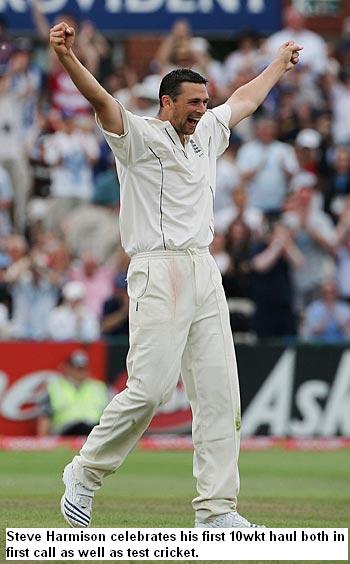
Steve Harmison took 10 wickets in an innings for the first time in his test career. Incidentally this also is the first time that he registered a 10 wkt-haul in a first class match.

Alastair Cook by hitting an 127 pushed his batting average to 59.40.

Danish Kaneria still maintains his record of having more test wickets than test runs among the bowlers who took 100 or more test wickets in a career.

Geraint Jones , who is dropped from the 3rd test team, still maintains his record of playing most number of innings in a test career without a single duck. Inzamam-ul-Haq finally gets dismissed for less than a 50+ score against England.