Sunday, August 27, 2006

Ashes Countdown 88

Hedley Verity - The Bowler Who Kept Bradman Under Control.

Enough has been written about the indomitable Sir Donald George Bradman and his 309 runs scored in a single day’s play. On July 11th 1930, playing in seventh test of his seven month old test career, Bradman made 105 runs before lunch, 115 between lunch and tea and added 89 more runs from tea till the end of first day’s play of the 3rd Test at Leeds. In the process, he completed 1000 runs in test cricket in just his 13th test innings when he reached the 138 run mark. He also completed 2000 runs for the season. At 21 years 318 days he became the youngest ever to reach 1000 test runs and also score a triple hundred in test cricket. Both those records were later obliterated. Sachin Tendulkar is the current record holder of youngest to aggregate 1000 runs at 19 yrs 217 days whereas Gary Sobers holds the record for being the youngest to hit a triple hundred at 21 yrs 215 days.

For a man who would end his test career with an astronomical batting average of 99.94, his test career did not begin as impressively as one would have thought. Making his test debut in the
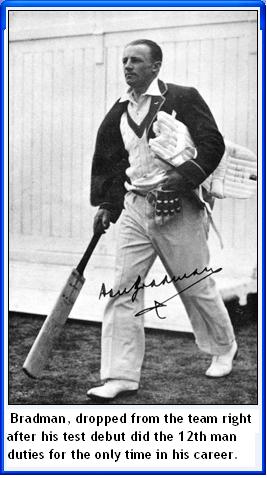
1st test of the 1928/29 Ashes at Brisbane after a string of tremendous scores in domestic Cricket, Bradman could make just 18 (batting at no.7) & 1(batting at no.6) in his maiden test appearance. Australia in that test was set a target of 742 runs for victory but folded out for a paltry 66. Whatever was the reason behind the selectors' choice of dropping Bradman for the 2nd test at Sydney, they must have cursed themselves for the rest of their lives for taking that decision. After all dropping Bradman, whether from the team or on the field, one will certainly have to pay a heavy price. Bradman carried drinks for the first and only time in his career as the twelfth man of the team.
Bradman returned with a bang and made 79 & 112 in the 3d test at Melbourne. 4th Test at Adelaide was relatively a low scoring match for Bradman as he made just 40 & 58. For any other batsman that would have been an excellent match, but as per Bradman’s standards it’s not even an average performance. In the 5th and final test Melbourne, Bradman again went back to his high scoring habit and made 123 & 37*.

After that Test series Bradman went on to hit nine more first class hundreds in next two seasons including a triple (340* vs Victoria in 1928/29) and a quadruple (452* vs Queensland 1929/30) and became an automatic choice for
1930 Ashes tour to England. English fans too were eager to watch this Boy wonder from down under. What a wonder he proved out to be… He did not disappoint their their aspirations.
Bradman hit a century in every test of the series except in the 4th test at Manchester which lost almost two day’s of play due to bad weather. His scores in that 5 test series were 8 & 131 at Trent Bridge, 254 & 1 at Lord’s, 334 at Leeds, 14 at Manchester and 232 at The Oval. His aggregate of 974 runs still remains as the highest aggregate in a test series and very unlikely to be surpassed.

Bradman’s 309 runs a single day is a world record for most number of runs scored in a day by one batsman. Needless to say they are the most number of runs scored by a batsman in a single day in Ashes too. Bradman not only holds the record for most number of runs in single days play, but also in a test series (
974 runs from five tests in 1930 Ashes) and in whole of Ashes (5028 runs from 37 tests @ 89.79). However Bradman missed the record for most number of runs in an innings and most number of runs a test match in Ashes. That record belongs to Len Hutton of England who made that unforgettable 364 against Australia in the highest ever innings total of 903/7 at Leeds in the 1938 between the arch rivals which resulted in highest margin for victory in test cricket by an innings and 579 runs. Brain Lara's 400* against England at St. John's in 2003/04 and Graham Gooch's 456 (333 & 123) against India at Lord's in 1990 are the best in test cricket.

The corresponding records in bowling too are not difficult to guess i.e., the most number of wickets taken by a bowler in an Ashes test in a single innings, a test match, a test series and in whole of Ashes.
Jim Laker’s 10 for 53 in Australia’s 2nd innings in the 4th test of the 1956 Ashes at Old Trafford and his match figures in the same test of 19 for 90 are not only the best by any bowler in Ashes but in entire test cricket history. Though his series aggregate of 46 wickets at 9.61 in 5 tests is the best in Ashes, England’s SF Barnes with 49 wickets at 10.94 against South Africa in 1913/14 holds the record for most number of wickets in any test series. Barnes played in only 4 tests of that series.

Jim Laker’s 10 wickets in an innings was later equaled by Anil Kumble, when he took 10 for 74
against Pakistan at Delhi in 1998/99 series. The most number of wickets taken by a bowler in whole of the Ashes does obviously belong to Shane Warne who in 31 tests has already taken 172 wickets at 22.31. If everything goes well for him Shane Warne might become the first bowler to aggregate 200 wickets against a single opponent during this winter.

But there are two bowling records which are not very well known: i.e., the most number of wickets taken in a single day’s play and the most number of runs conceded by bowler in an innings of any Ashes Test. No doubt bowlers from either side would be trying to emulate one of them and avoid another. The record for most number of wickets taken in a single day’s play by any bowler in test cicket belongs to England's Johnny Briggs. In the
2nd test of the 1888-89 series played at Cape Town, South Africa started their second day at the score of 2 for 1 after bowling out England for 292 the previous day.

Johnny Briggs then produced a magical spell of 7 for 17 to dismiss South Africa for a meagerly total of 47 with AB Tancred carrying his bat for 26. When South Africa was asked to follow on no one thought their performance in the 2nd innings will be even worse. Johnny Briggs again being the wrecker-in-chief as South Africa was skittled out for 43. Briggs bettered his 1st innings analysis by getting 8 wickets for 11 runs. The most remarkable thing about Briggs wickets was except for NHCD Theunissen’s wicket in South Africa’s innings he obtained all his wickets by clean bowling the batsman. 117 years have passed since he set this record, but the 15 wickets he took that day still remains as the record for most number of wickets taken by a bowler in a single day. To South Africa’s credit it was just their 2nd ever test match and they were taking their baby steps in test cricket.
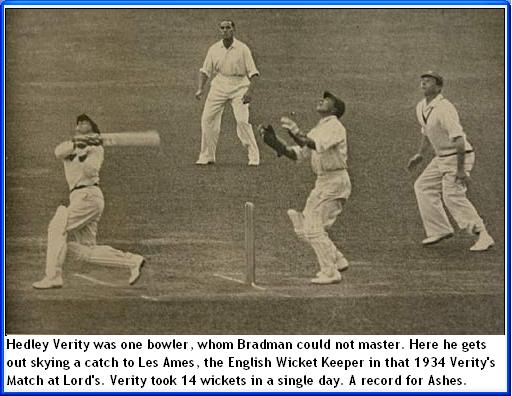
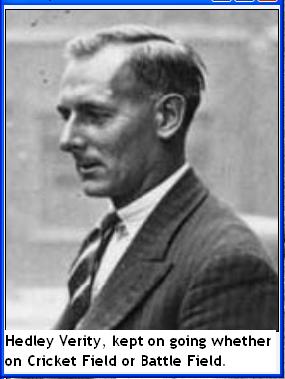
Another bowler, Hedley Verity who 46 years later bowling to one of the best batting line-ups in history of cricket, came tantalizingly close to equaling if not beating Briggs record. In the second test of the 1934 Ashes, playing at the Mecca of cricket, Lord’s, Hedley Verity bamboozled the Australia’s batsmen with his slow orthodox spin after the weekend rain made the perfect batting track on which England piled up a big total of 440 with centuries from Maurice Leyland and Les Ames. Verity too chipped in with a score of 29 and added 50 runs for the 8th wicket with Ames. By the end of second day Australia were well on their way to even bigger total with Bill Brown playing his second test on 13 and Stan McCabe on 24 still batting.

Though they lost Bradman for 36 caught and bowled by Verity there was not a slightest hint of what was in store when play resumed after the scheduled rest day. The rain that fell on the rest day made the track offer some assistance to the spinners, but it was really Verity’s aggressive but controlled spin bowling that made it look treacherous. Verity ran through the Australian Innings and claimed six of the remaining wickets once Bill Bowes made the initial breakthrough getting Bill Brown’s wicket for 105. Verity improved his bowling figures from 1 for 24 at the end of second day’s play to 7 for 61 as Australia was bowled out for 284 and forced to follow on. In the second innings Australia’s batting was even more pathetic as their batsmen had absolutely no answer to Verity’s deadly spell of 8 for 43 and were bundled out for 118 giving an innings and 38 runs victory for England.

Verity took the wicket of Bradman in both the innings. His 14 wickets on that day still remains as the most by any bowler in a single day's play of an Ashes test. Verity also shares that same record in entire first class cricket with two other bowlers. While playing for Yorkshire during the previous summer against Essex Verity took 17 wickets in a single day as Essex were bowled out for 104 and 64 on the same day. His analysis read 8 for 47 and 9 for 44. His 17 wickets equaled a record for most number of wickets in a single day’s play in all first class cricket set by Colin Blythe of Kent against Northamptonshire at Northampton in 1907. Tom Goddard of Gloucestershire joined them as the 3rd bowler by taking 17 wickets in a single day against Kent at Bristol in 1939. The last day of that season, Hedley Verity produced another lethal bowling spell of 7 for 9 to dismiss Sussex for 33 and help Yorkshire beat Sussex and win the 1939 county championship.

As he walked out of the ground after the match, he uttered the prophetic words sensing the imminent war “'I wonder if I shall ever howl here again.” He did not as two days after England declared war on Germany and that proved out to be the last day of 1st class cricket before the World War II for English cricket. Unfortunately for Hedley Verity too that remained as the last day of his first class cricket career. Verity joined the British Army and served his country in a different role altogether. He was sent to Ireland, India and Sicily on military assignments, the last of which as captain. He was badly wounded while leading his troops in 1943 during the allied invasion of Sicily and was taken as prisoner by Germans. He died of those wounds in a POW camp on July 31st, 1943 in Caserta, Italy after being handed over to Italian troops.

He was just 38 years when he died. Verity’s first class debut came very late at an age of 25 years in 1930 when Bradman was making his first tour of England. He made the similar kind of impact on Yorkshire’s bowling as Bradman did Australia’s batting. He did not play the full season in his first year in first class cricket and never got a chance to bowl at Bradman. However his first victim in Ashes was that of Don Bradman whom he always perplexed. In fact Verity took Bradman’s wicket 8 times thrice clean bowling him and twice catching off his own bowling. Bradman himself said about Verity: "I think I know all about Clarrie (Grimmett), but with Hedley I am never sure. You see, there's no breaking point with him."

In all Hedley Verity played 40 tests and took 144 wickets at 24.37. Unlike many of the tail end batsmen of his time, he did bat and made valuable contributions to England’s innings many a time like the 29 runs he made in Lord’s Test of 1934. He in fact opened the batting for England in both the innings in the 4th test of the 1936/37 Ashes at Adelaide and came in at number 3 position in the 2nd test of the 1938 Ashes at Lord’s. By no means was he a rabbit with the bat. His 669 runs in test cricket were attained at a decent rate of 20.91 which included 3 fifties. In 1935/36 when Yorkshire toured Jamaica to play some first class matches, his bowling helped Yorkshire end Jamaica’s track record of not losing a first class match for 10 years. This time he tied down the Black Bradman, George Headley and dismissed him cheaply in both the innings. On that tour he also hit his only century in first class cricket.

He topped the county championship bowling averages in his first season with 64 wickets at 12.42 as he started halfway through and did not play all the matches. For the rest of his cricketing career he took at least 150 wickets every season.

In successive seasons during a 3-year period between 1935 and 1937 he took 200 wickets. His bowling average was never above 18 and in his maiden season 1930 and final season 1939 he topped the bowling averages and never went below the 5th position in between. Verity’s strike rate of 14.87 for the 1,956 wickets he has taken in first class cricket was bettered by very few bowlers in history of cricket who claimed as many wickets: Alfred Shaw, 2,072 wickets at 11.97 each; Tom Emmett, 1,595 wickets at 13.43 each; George Lohmann, 1,841 wickets at 13.73 each; James Southerton, 1,744 wickets at 14.30 each. All those bowlers bowled during the period 1854 to 1898, when pitches offered more assistance to the bowlers than they did in 1930s.
He also took 10 wickets in an innings in a first class match on two separate occasions. Both of which came at Leeds. In 1931 playing against Warwickshire he took 10 for 36 and the following season came his famous 10 for 10 against Nottinghamshire, which still remains as the best bowling figures ever in first class cricket. Notable fact about the feat was that his county colleague George Macaulay though helped him by picking three catches of Verity’s bowling, he refused to bowl wides to help Verity achieve the record, which makes Verity's feat even more appealing among all the All-Ten hauls in an innings. At one stage Hedley took 7 wickets for just three runs in 15 deliveries, including the hat-trick. His final figures read 19.4-16-10-10 and his is the only 10-wicket haul in an innings to include a hat-trick.

Verity always enjoyed his one-on-one encounters with Bradman. In the 16 tests that they played together Verity conceded just 401 runs to Bradman and claimed his wicket 8 times, which meant Bradman could score only at half of his career average against Verity. In the 18 Ashes tests that were played during Verity’s test career span, Bradman did not play in the first test at Sydney of the Body-line series and Verity did not play in the 5th test at The Oval in 1938 in which Bradman too could not bat as he was absent hurt. In this test LO Fleetwood-Smith of Australia conceded most number of runs in an innings by a bowler in the history of test cricket. Len Hutton made that record breaking 364 and with big hundreds from M Leyland (187) & J Hardstaff Jr (169*) England recorded the highest total in an innings (903/7) in any Ashes test and the highest in test cricket at that time.

Writing his obituary in Wisden’s almanac edition of 1944 R. C. Robertson-Glasgow said: “it was Verity who kept Bradman’s average under 150”. I don’t think anybody would disagree with that. Bradman himself once wrote, “I could never claim to have completely fathomed Hedley’s strategy, for it was never static or mechanical.” There can be no better tribute to this great bowler who always kept on going whoever his opponent was, whether on cricket field or on the battle field. In fact the last words that his troops heard when he was hit by enemy’s fire on that fateful night in Cicily were "KEEP GOING…
KEEP GOING...."

Sir Clyde Walcott - Another Obituary For The Week

This Week looks like a week of Obituaries for Test Cricket. First it was Pakistan’s Wasim Raja (54) who collapsed on the cricket field on Aug 23rd, 2006.

Yesterday, Aug 25th 2006, it was India’s Vijay Mehra (68): the youngest cricketer ever at 17 years and 265 days to have played for India when he made his debut along with Nari Contractor, against New Zealand at Bombay in 1955/56. His record subsequently was taken over by Sachin Tendulkar. Vijay Mehra played just eight test matches and aggregated 329 runs at 25.30 with the help of two fifties. He batted with a fractured thumb to record his highest test score of 62 against Ted Dexter’s Englishmen at Calcutta in 1961/62, which India won by 187 runs. He also made an identical score against West Indies in the same season in the 4th test at Port of Spain and added 144 runs in an entertaining partnership with Salim Durani. Vijay Mehra also served as a National Selector and very popular as AIR commentator having visited the West Indies on behalf of All India Radio during the 2006 series.

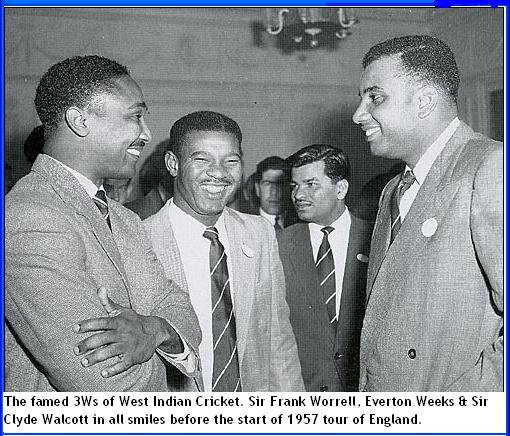
And today it’s none other than the West Indian great Sir Clyde Leopold Walcott , a member of the three Ws who helped shape the West Indian Cricket after World War II. He died earlier today i.e. Aug 26th, 2006 in a Barbados Hospital. He was 80 years old. Both Barbados and West Indies lost one of their famous cricketing sons and the international cricket community lost a great amasaador of cricket. He was one of the famed triumvirate of the three Ws along with Frank Worrell and Everton Weeks. Walcott was the original version of Vivian Richards who believed in attacking right from the word go and treated the bowlers all over the world with utter disdain.

In a career spanning over a dozen years, Walcott aggregated 3,788 runs in 44 Tests with 15 centuries and 14 fifties from 1948 to 60. His batting average of 56.68 stands at 10th position in the list of batsmen who scored 3000 runs or more in test cricket. . He is one of the very few batsmen who had scored 15 or more centuries yet had a higher conversion ratio of 50s to centuries. Only Don Bradman of Australia and Mohammed Azharuddin of India have better conversion ratio in that category.

Walcott kept close ties with the game unlike his other contemporary Everton Weeks, who preferred to stay away from the limelight. The other great ‘W’, Frank Worrell died in 1967 at an age of 42. Clyde Walcott after retiring from cricket coached the Barbados team in the Shell shield, the premier tournament among the Island nations. Then he went on to manage the West Indian team and their successful World Cup campaigns. Later on he got into bigger administrative roles as Selector and president of the West Indies Cricket Board.

Its not an accident that during his tenure at the top of West Indies Cricket Administration West Indies saw their golden period of late 70s to early 90s but his thoughtful actions that led West Indies to register a record 15 test series, It does not surprise me, his resignation in 1993 from that position to become the ICC Chairman, started the slow demise of their glory over the years and made them as another average team. He was knighted in 1994, one year after taking charge as ICC Chairman for his services to the West Indian and International cricket and its administration. He also stood as ICC Match referee for three test matches involving Pakistan and England during 1992.

During his 6 years tenure as the Chief of ICC Walcott introduced many procedures that streamlined the Administration and made his successors' job much easier. It’s a testimony to his administrative acumen that the most of the controversies that gave tumultuous times to cricket all over the world occurred well after his term.

After his term as ICC Chief, Walcott continued his service towards the betterment of cricket and traveled distances and lived like a true ambassador of cricket. Though his health was deteriorated in recent times he rarely missed watching a cricket match played in Barbados which was of any importance. As Rudi Webster, a former manager of West Indian cricket team said, Walcott was an icon and was truly a great man, his contribution being invaluable to both Barbados and West Indian Cricket.

Everton Weeks, now the lone surviving member of the three ‘W’s gave this tribute to his long-time friend and partner in destruction of the bowling attacks of the World during the golden age of West Indies batting, has this to say about Walcott: “ Clyde had a powerful physique and his batting was based on power and strength, He hit the ball harder than any of us. Walcott kept wicket in 15 Tests before back problems forced him to give it up. He was a true friend and a great man. Whenever I batted with him I enjoyed it, and we have some great times together on and off the field. He was a pretty quiet person but would always find time to talk to you and find out what was going on.”

Walcott did bat with extreme power and the shots he executed of his backfoot were brutal. It is very rare that a batsman of his height, 6’ 2’’ could execute strokes of his backfoot with so much timing and power. “Well, it was just my style of play. I don't think it had anything to do with my height; I just batted that way. I was pretty strong off the back foot, but that doesn't mean I didn't play off the front foot as well. It depended on the bowler and on the pitch of the ball, you know, so it was just my style.” Walcott explained in an interview to John Ward, the editor of Zimbabwe Cricket Online. Walcott liked his style and the results that were yielded so much, he named his autobiography as ‘SIXTY YEARS ON THE BACKFOOT’.

Walcott broke into prominence in 1945-46 when he and his schoolmate Frank Worrell belted the Trnidadian attack to pieces in an unbeaten fourth partnership of 574 for Barbados. It still remains as the highest partnership for a West Indian pair in any first class match. Two seasons later he made his international debut in his hometown against England in the first test of the 1947-48 series at Bridgetown. Though he did not do much in that series with scores of 8 & 16 in his maiden test, 20 & 2 in the 2nd test at Port of Spain, 11 & 31* in the 3rd at Georgetown and 45 in the 4th and final test at Kingston as a batsman, his wicket keeping skills which fetched him 16 dismissals (11 Cts & 5 Sts) kept him in the side that toured India the following season in 1948/49. This is the series in which Walcott graduated into a powerful batsman that he remained for the rest of his career. He made 452 runs at 64.57 which included two hundreds and two fifties.

He made a punishing 168* against England at Lord’s in 1950, which aided by the spin twins Valentine’s and Ramdhin’s bowling won the test for West Indies by 326 runs. Except for that one big score and another century against New Zealand at Auckland in 1951/52 Walcott did not achieve much for the next 10 tests. But India, as they have done to many an out of form batsman, gave him a break again when they toured Caribbean islands in 1952/53. Walcott compiled couple of easy hundreds in the 4th test at Georgetown and 5th test at Kingston against their friendly attack. In the fifth test, which ended in a tame draw, all three Ws scored a century with Worrell making it a double.

The next two seasons Walcott hit a purple patch and provided one of the hottest streaks in test cricket. He began the 1953/54-test season with scores of 65 & 25 against England at Kingston. But it was his innings of 220 out of a West Indian total of 383 at Bridgetown in the 2nd test that catapulted him into the newer heights taking his test batting average to 50s. He made another century in the 4th test at Port of Spain where the 3 Ws again scored a hundred and Weeks making it a double this time. The 5th test brought another hundred for Walcott in a lost cause as England won the test by 9 wickets and tied the series 2-2.

Walcott aggregated 698 runs in that series including 3 hundreds and 3 fifties at an average of 87.25. If that was not taken seriously by the Australians who dismissed him cheaply in 3 tests of 1951-52 Series in Australia as Walcott made just 87 runs at 14.50 , they soon realized how wrong they were. Walcott scored 827 runs against an attack which consisted Lindwall, Miller and Benaud among others. He hit a century in each innings of both the 2nd test at Port of Spain and the 5th test at Kingston on top of his 108 in the 1st test of the series at Kingston. His 5 centuries in that series still remain as the most by any batsman in a single test series and his series aggregate which stood highest by any West Indian cricketer 22 years, was surpassed by another Knighted and powerful hitter Sir Issac Vivian Alexander Richards by 2 runs during the 1976 summer in England. Richards scored those 829 runs in just 4 tests.

After those two dream series Walcott could not repeat the same kind of form and added just one more century hitting his last and 15th century of his test career against Pakistan at Georgetown in the 4th test of the 1957/58 series and shared a 269 run partnership with another West Indian batsman who just made a world record score in the previous test at Kingston. That series marked the end of one of 3Ws, Everton Weeks Career. Walcott played just two more tests before hanging up his boots as well, while Frank Worrell continued playing till 1963. Gary Sobers took over where the great 3Ws left off in keeping the glory and glitter of West Indian Cricket aloft.

In addition to his 3798 runs from 44 tests, Walcott took 53 catches and affected 11 stumpings. When he stopped keeping the wickets after 15 tests he did some occasional medium pace bowling which accounted for 11 victims. Walcott stayed in touch with the game till he took his last breath. Thus the glorious life of Clyde Walcott, which began on January 17th of 1926, comes to an end. One could not have put it in a much better way than Michael Holding, who paying his tribute to this great character, said “Clyde, he wouldn’t wait for you to ask him, he would approach you and try to help” . Yes, Walcott did help the West Indies cricket both as a player and as an administrator as much as if not more than any other single individual,, but was so humble and full of humility while answering in an interview when asked why he continued to work so hard.: Walcott said : "Cricket has done so much for me that I can't do enough for cricket" .

Thursday, August 24, 2006

Wasim Raja - A King among Men.

There are some test cricketers whose test record doesn’t speak about their true talent and enormous entertainment they have given to the spectators all over the world with their batting or bowling or fielding. Wasim Hasan Raja who died at age of 54, while playing for Surrey in an Over 50s match yesterday at Marlow in Buckinghamshire. August 23rd, 2006 is definitely one of those cricketers. Not only Pakistan, but the entire Cricketing world has lost a great cricketer and a true gentleman. A tremendous crowd puller and a charismatic cricketer Wasim Raja remained a favorite among the cricketing fraternity through out his life. His Test cricket record of 57 tests over a two decade period during which he aggregated 2821 runs at an average of 36.16 with 4 hundreds and 18 fifties and 51 wickets at 35.80 though may not really reflect the abundance of talent he possessed as an all-rounder, the way he took upon the bowlers and batsmen of the cricketing world was a treat to watch for those who were fortunate enough to see his exploits on the field. Living upto his name Raja - he Played the game like a King among Men.

With a remarkable coincidence Wasim Raja’s younger brother Rameez Raja, who went on to achieve more fame as cricket administrator and commentator, too had played 57 tests and scored just 12 runs more but scored two hundreds less and had a lower avg of 31.83. Considered as Pakistan’s Gary Sobers Wasim Raja was truly loved by every cricket lover all across the world for his breathtaking stroke play. He believed in enjoying cricket rather than burdened by it and never bothered in accumulating records. In addition to that the way he kept himself away from all the controversies that are part and parcel of any Pakistani test cricketer’s career is something else that need to be commended. He kept himself above the politics of Pakistan Cricket

His performance in just one tour of Pakistan in West Indies during 1976/77 itself is enough to make him rated among the greatest left hand batsmen of all-time. Prior to that series Wasim Raja made just nine test appearances with just one century to his name which too incidentally came against the mighty West Indians during their 1974/75 tour of Pakistan in the 2nd test at Karachi. When Windies under Clive Lloyd’s captaincy were on top of the world with their fast bowling battery firing on all cylinders, this young left hander with just nine tests experience but with full of promise stood tall. Without wearing any headgear he clobbered all their pacemen and shred their attack to pieces and sent them to every corner of the cricket field. West Indies introduced two new demons with the ball Croft and Garner in the 1st test adding to their already seasoned and menacing attack which included the likes Roberts, Holder and Julien. Injury helped Michael Holding to escape Wasim Raja’s murderous assault of West Indian Pace attack. The short framed and an elegant player Wasim Raja, who almost always sported a thick beard during his test career registered scores of 117* & 71 at Bridgetown, 65 & 84 at Port of Spain, 5 & 0 at Georgetown, 28 & 70 at Port of Spain and 13 & 64 at Kingston which came at an alarming speed and along with a flurry of over the boundary hits.

Such was the power of his batting and the disdain with which he treated the West Indian fast bowlers, by the end of the test series he became the first batsman to have hit 14 sixes in a test series and became an instant hit among the cricket fans both in Pakistan and all parts of the world who hated seeing their batsmen being tortured by the vicious bowling spells by the Caribbean speedsters. No batsman ever since was able to cross that number though Andrew Flintoff against South Africa in 2003, Mathew Hayden in 2003-04 against Zimbabwe, Kevin Pietersen against Australia in 2005 and Shahid Afridi against India in 2005-06 equaled that record.

In the first test at Bridgetown he gave an indication of things to come from his bat by remaining not out with 117. He almost doubled Pakistan’s score from 223/6 to 435 just with the company of tailenders. Then in the 2nd innings when Pakistan were 158/9 with just 172 runs ahead he produced an amazing partnership with Wasim Bari to add 133 runs for the last wicket which enabled Pakistan to set a target of 306. In reply West Indies were 237/9 at one stage but test debutant Colin Croft and seasoned tail-ender Andy Roberts battled it out to save the test match. Raja’s was a match changing innings and for exactly this type of innings which became his hallmark and made his name permanently etched in Pakistan’s Cricket History. In the 2nd test at Port of Spain he again top scored in both innings for Pakistan with knocks of 65 & 84 including couple of towering sixes in both innings but could not avoid Pakistan losing the test match by 6 wickets. I wonder how many players were able to achieve that feat of top scoring in 4 consecutive completed innings in test history. I don’t think there will be many. May be I will write another Statistical piece on this.

Wasim Raja failed for the 1st time with scores of 5 & 0 in the 3rd test in a drawn encounter but in the 4th test at Port of Spain he made 28 in the 1st innings and top scored with 70 in the second to extend the winning target for West Indies to 489 and cleaned up the stubborn and resisting tail-enders of West Indies in just 3.5 overs returning with figures of 3 for 22 to let Pakistan register their only victory of the series. In the fifth test which West Indies won by 140 runs, Raja made 13 runs in the first innings which included 2 sixes and in the 2nd with the help couple of more sixes he made 64. He took 3 for 65 in the only innings he bowled. His victims in the 2nd West Indian innings were Roy Fredericks, Vivian Richards whom he clean bowled and Clive Lloyd.

On that tour of West Indies Raja topped both batting 517 runs at 57.40 and bowling averages 7 wickets at 18.71. Though he never delivered the kind of things that Pakistan expected of him he played several short and sweet innings during his career.

It’s very unfortunate that the selectors did not put enough faith in this swashbuckling and graceful left hander and rather went for traditional run machines curtailing his test career to just 57 tests. He did hit two couple of centuries and couple of nineties after that amazing 1976/77 tour first of which came seven years later against India in the second test at Jalandhar of 1983/84 series. Again he came to the rescue of his side by hitting a brilliant century after Pakistan were reeling at 169/7 and was the last wicket to fall at 337 adding 168 valuable runs with the tailenders. His 125 was again the top score for Pakistan’s innings. Wasim Raja also took 4 wickets for 50 runs in India’s innings of 374 as the match petered into a rain ruined draw. Both those figures remained his best in Test Cricket. He played his last test in 1984/85 against New Zealand at Auckland and was forced to retirement at relatively an young age of 32. For a player of his caliber his one day career was not that significant and in the 54 matches he played he reached the fifty mark just twice and aggregating just 782 runs at an avg of 22.34 and claimed 21 wickets @ 32.71

He did serve as ICC Match referee between 2002 and 2004 for 15 tests and 34 ODIs which included eight matches of 2003 World Cup in South Africa. Whatever his record says Wasim Raja will remain as one of the most graceful players to have donned the cricket field. He enjoyed cricket and spectators all over the world enjoyed watching him and it’s a fitting tribute to this great cricketer and greater human being that he took his last breath in a place where he enjoyed most. A Cricket Field.

Monday, August 21, 2006

Test #1814 Records Sidelined..

Test #1814 Pakistan in England (4th Test) at The Brit Oval, Kennington.

This test match, no doubt will go down into the record books, but for all the wrong reasons and as the first ever forfeited test match which was marred by chaotic scenes, deafening boos by the spectators and unbelievable turn of events and finally the way it concluded with four sessions still remaned to be played. This definitely will occupy the number one position in my book of cricket controversies and will surely be recorded as one of the darkest chapters in the annals of test cricket.

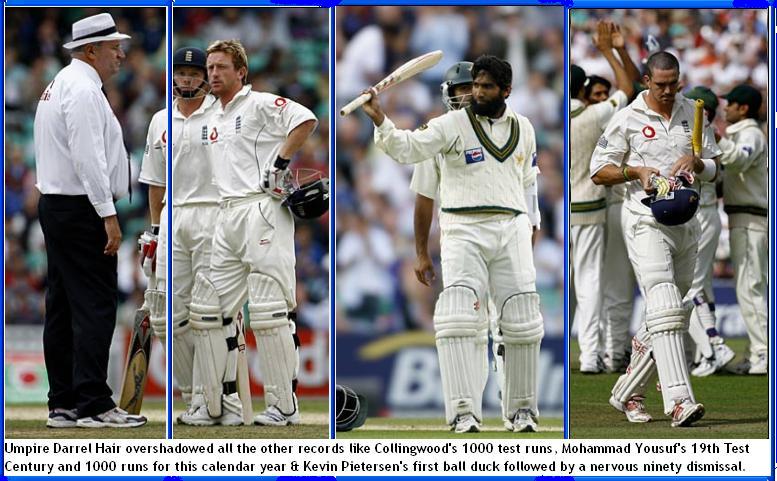
Paul Collingwood’s completion of 1000 runs in test cricket making him the 90th Englishman and 425th test cricket to reach that milestone, Mohammad Yousuf’s 19th century of his test career taking him past the 1000 run mark for this calendar year at 1123 runs from eight tests at an average of 86.38 with five hundreds and two fifties, both the Pakistani openers getting dismissed with 90+ scores and Kevin Pietersen’s 1st ball duck followed by a nervous 90s dismissal may have been considered as the statistical highlights of this test had it been proceeded in its normal course rather than ending in chaos referring to the books of cricket laws.

Younis Khan missed the opportunity to reach the 1000 runs in calendar year milestone by just two runs. Pakistan’s Kamran Akmal for the 2nd time in his test career had 16 dismissals in a series (14 catches & 2 stumpings). Earlier against West Indies in 2004/05 test series he took 15 catches and made 1 stumping. It is Kamran Akmal's second series of 4 or fewer test matches with 16+ dismissals. Thus he joins four other wicket keepers Adam Gilchrist & Rodney Marsh of Australia, Dave Richardson of South Africa and Mahendra Singh Dhoni of India who have all achieved the same record with every one except Dhoni and Akmal doing it thrice in their careers.

In the previous test at Leeds, Kamran Akmal claimed his 100th test victim behind the stumps thus becoming the 32nd test cricketer and fifth Pakistani wicket keeper after Wasim Bari, Salim Yousuf, Rashid Latif and Moin Khan to have done so. Incidentally except Australia’s Wally Grout (890 runs) and West Indies’ Junior Murray (918 runs) , all the wicket keepers who had 100 or more dismissals in their career also aggregated 100 or more runs in their test careers to achieve the double of 1000 runs & 100 victims.

Danish Kaneria finally removed his name from the record books by making 15 runs in 1st innings which puts his test career aggregate of 175 runs from 40 tests above his 167 tally of test wickets. Now only BS Chandrasekhar of India and Bruce Reid of Australia holds the record of taking more test wickets than making more test runs among those players who have taken 100 wickets or more in their test career

So finally curtains are drawn on 2006 season of Test cricket, though not in a way one would have expected. But this test match made sure that there will be enough material to ponder upon for everyone assosicated with the game of cricket. The media or cricket fans or administrators around the world can not complain for shortage of topics to debate and argue upon till the next season kicks off.

Sunday, August 20, 2006

What...? A Forfeited Test...?

What....? We have a Forfeited Test match….?

Fortunately for cricket lovers of the world we still do not have a forfeited test match in Ashes history. For that matter forfeiting a Test match is never heard of in 129 years and 1813 test match history. That’s until today. With Pakistan forfeiting the 4th test at The Oval, a new chapter is now being written in the history of test cricket. It still puzzles me how the events were unfolded to let the Oval test take the course it has taken. Especially, as many as sixteen overs were bowled as England took their score from 230 for 3 to 298 for 4 after the triggering event.

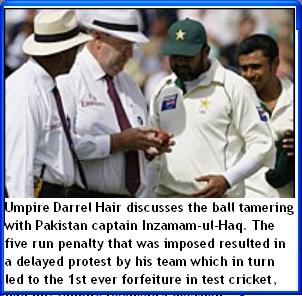
At the end of the 56th over of England’s innings, which was Umar Gul’s 14th, England was cruising along at 230 for 3 and was getting closer to wiping out the deficit. Then the umpires Darrel Hair of Australia and Billy Doctrove of West Indies consulted each other while inspecting the ball and asked for a change of ball. Darrell Hair looked particularly very unhappy about the condition of the ball and also signaled the scorers for awarding five additional runs, which under the prevailing cricket laws means the fielding team may have tampered the ball to take advantage of the reverse swing that it would generate making it the first such occurrence of a 5 run penalty being imposed for ball-tampering. There were absolutely no signs at that time about the chaos that would unfold very soon in front of a packed and sell-out crowd at The Oval.

The game continued for further 16 overs when bad light stopped play and an early tea was taken. When play was about to start with both the umpires coming on to the field Pakistan refused to come on to the field as a protest over the ball tampering allegation and subsequent five runs penalty imposed on them. The umpires were soon joined by English batsmen Collingwood & Ian Bell but there were no signs of Pakistan team coming out. So at around 5 pm the umpires took of the bails indicating the conclusion of the test match. No announcement was made to the waiting public resulting in an utter confusion both in the stands and in commentary box. About an half an hour later Pakistani team took the field amidst the echoing boos only to know that Darrel Hair was not interested in coming back to the field and as per the Cricket Law 21.3 which says “"that, in the opinion of the umpires, a team refuses to play, the umpires shall award the match to the other side" the test match has officially ended

What baffles me most is why Pakistan waited till the break to protest. If they were upset for getting accused for ball tampering and therefore “Cheating” as put forth by their coach Bob Woolmer, they could have done it when the five penalty runs were awarded. Also puzzles me is the fact whether umpire Hair have enough evidence to bring such an anti-climactic end and controversial finish to an otherwise an evenly poised and extremely entertaining test match in which Pakistan had an upper edge.

Protesting over umpire's decision is not new to Test Cricket. In fact there were several incidents in test history in which the umpires were the targets of players’ fury and there by drawing their wrath, though most notable ones have occured during the modern times. First of such incident happened way back in 1973 test at Edgbaston between West Indies and England when Arthur Fagg refused to take the field for a while to protest against the West Indian Players reaction to one of his umpiring decisions. Clive Lloyd's West Indian team refused to take the field after the 3rd day's tea break unless umpire Fred goodall of New Zealand was replaced in the 1980 Dunedin test between New Zealand and West Indies causing a delay of 12 minutes. The organizers then managed to persuade the visitors to take the field. But situation worsened so much after that at one stage during the test West Indies wanted to abandon the whole tour. In 1987 test at Faisalabad, Shakoor Rana of Pakistan took one step further when he demanded a written apology from England Captain Mike Gatting before he came on to the field.
But none of those test matches went as far as forfeiture. The closest a test match ever gone to the point where a forfeiture looked imminent was surprisingly not initiated by an umpire’s reaction but by none other than the little master Sunil Gavaskar‘s reaction. Gavaskar after showing his anger at an lbw decision handed over to him by Rex Whitehead of Australia in 1981 Melbourne test, started his walk back to the pavilion reluctantly but heard a comment from the bowler Dennis Lillee on his way back which infuriated him so much that being the captain of the team he asked his partner Chetan Chauhan to walk off the field with him.

If Wing Commander Shahid Durani, the manager of the Indian team had not intervened the situation to stop Chauhan at the boundary gate and instructed Dilip Vengsarkar, the next batsman to get on to the field in time to resume the batting, India would not only have become the first ever team to have forfeited a test match but also may have denied Indian cricket fans an opportunity to witness one of the greatest test match victories. Australia failed to reach an extremely low target of 143 runs and were bowled out for 83. I still cannot forget Ghavri dismissing Greg Chappell first ball he faced and an injured Kapil Dev’s unbelievable spell of 5 for 28.

So The Oval Test Match between Pakistan and England which ended in Pakistan forfeiting and England getting awarded a win which came almost 25 years after another test which went almost to the same boiling point may have very well set a precedence to what we might expect going forward unless some stricter measures are taken up by ICC to combat such incidents,

As a cricket fan I really feel I am deprived of enjoying a good test match finish. I am sure the spectators at The Oval must be feeling the same in spite of getting refunded a 40% or their ticket price for today’s play and 100% for tomorrow’s play.

Ashes Countdown 96

If I am asked to choose the most defining moment in Ashes history or for that matter in the test cricket history itself, which has completely altered the whole landscape of test match cricket and made Australia as the most dominant force in test cricket, without thinking twice I will give my vote to the 1989 Ashes series.

Branded as the weakest Australian team ever to visit England, Allan Border’s Australian team under the able tutelage of their coach Bob Simpson, started their 1989 summer campaign on May 7th with the traditional match against Duchess of Norfolk XI. They beat them by 120 runs in a limited over match and then went on to win four more such games against non-county teams. Neither English Press nor the fans did give much importance to those games as they knew very well that Australia did not win a single test series of any importance under Allan Border’s captaincy. Ever since Kim Hughes broke down with tears on that fateful day of Nov 26th 1984 while reading his resignation speech, Australian cricket touched the nadir and went into a period of darkness, which given a chance and if at all possible every Australian would like to erase from their memory.
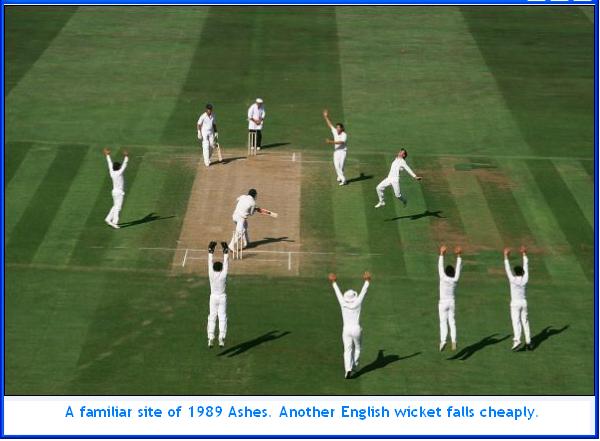
Here is how they fared under Allan Border ever since he was forced into the leadership role after Kim Hughes resignation and emotional breakdown

1-3-1 loss to West Indies in Australia 1984/85 (1st two tests were captained by Kim Hughes)
1-3-2 loss to England in England 1985
1-2-0 loss to New ZeAlland in Australia 1985/86
0-0-3 draws with India in Australia 1985/86
0-1-2 loss to New Zealand in New ZeAlland 1985/86
0-0-3 draws with India in India 1986/87
1-2-2 loss to England in Australia 1986/87
1-0-2 win 0ver New ZeAlland in Australia 1987/88
0-0-1 draws with England in Australia 1987/88
1-0-0 win over Sri Lanka in Australia 1987/88
0-1-2 loss to Pakistan in Pakistan 1988/89
1-3-1 loss to West Indies in Australia 1988/89

That’s 7 wins, 15 losses and 19 draws in 41 tests. Under Border’s captaincy Australia won just one out of 9 series over a period of 4 1/2 years. It sounds unthinkable for a side which dominated the world cricket for the last 17 years or so. England too did not do that well during that time as Viv Richards transformed his West Indian team with a four-pronged pace attack as the most fearsome side ever. England suffered two white washes at their expense but kept their pride intact by winning both the series that mattered most to English cricket. The Ashes.

So expectations were naturally high in the English camp, when the “the weakest Australian side ever to tour England” set foot on their soil. The entire Australian team knew that they were the underdogs and needed to take their performance levels to a whole different platform. But just to make the matters worse in the first serious game of the tour Australia was bowled out for 154 runs and lost to Sussex by 4 wickets in a limited over match and then to Ian Botham led Worcestershire side by 3 wickets inside two days in their 1st first class game of the tour by getting folded for 103 in the 1st innings and 205 in the 2nd . The whole British press and the fans were preparing for a one-sided affair and were hoping the test matches would be stretched over at least to the final day. They soon realized their preparations for the most one-sided test series ever did not go waste.

Australia did give an indication of things to come when they successfully chased a seemingly high target of 278 losing just 4 wickets in the 3rd ODI at Lord’s. After getting thrashed in the 1st ODI at Old Trafford Australia came back strongly to tie the 2nd ODI at Trent Bridge and in the end shared the honors with England.

Even then .. England thought they had the upper hand in that series and were under the impression that the test matches would be a whole different ball game and they don’t have match for them, especially in English conditions when the swing and seam of their bowling attack can do the talking there is no way that Australia is going escape another drubbing in their hands.

So when David Gower won the toss at Leeds for the 1st Test , without flinching a wee bit he put Australia into bat and when Australia lost 2 quick wickets with just 57 runs on the board there were many faces in the stands, members pavilion and English dressing room which showed an expression of “ I told you so….”.

Precisely that’s when I believe the defining moment may have occurred. Allan Border the Aussie captain joined Mark Taylor who was making his Ashes debut and had played just two tests prior to this and was trying to prove himself. Both of them were under tremendous pressure to perform but were bent upon proving the pundits wrong and do not let English team take the upper hand in the series. Taylor grew in confidence with his captain guiding him through the initial phases of his innings. Also both the batsmen being grafters they build the innings slowly but surely and gave preference to patience than flamboyance to add 117 runs for the 3rd wicket before Border was caught by Foster of the bowling of De Freitas. Then Dean Jones, not known to the cricketing world as much as he is now, joined Mark Taylor and by the end of Day One Australia 207 for 3 with Mark Taylor four runs short of his century. The next day both Taylor and Jones continued piling up runs before Taylor got out for a career altering 136.

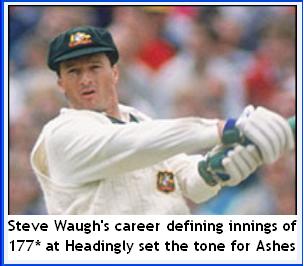
Then walked in the new batsman to the crease in a baggy green cap looking like a picture perfect cricketer reminding old timers of the bygone era of helmet-less batting. At last the Aussie wonder has proved his full potential and lived up to the faith the selectors had kept in him over the years. If you were told that the batsman had already played 26 tests without making a single century since his test debut in 1985 and scored just 1099 runs at an average of 30.53, you would not have believed he would become one of the greatest cricketers of all time. Yes, Stephen Rodger Waugh, who till then was just a shadow of what he would achieve in cricket history, played one of the greatest career defining innings that test cricket has witnessed.

Steve Waugh made a classic 177* adding in the process 138 runs for the 5th wicket with Dean Jones and then further 147 runs with Merv Hughes by the time Australia declared their innings closed at 601/7. England though avoided the follow on could not really recover from the shock and when Australia made a quick 230 for 3 and closed their innings to let England survive 83 overs for a draw or chase 402 runs for victory the writing was on the wall. Lawson, Alderman and Hughes made sure that England can not take them for granted by bowling them out for 191. From that point onwards the Ashes series turned out to be one-sided as completely and as thoroughly as English press predicted before the Australians even landed. Unfortunately it went in favor of the other side.

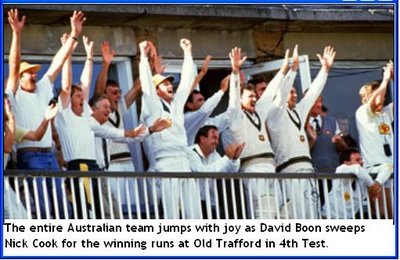
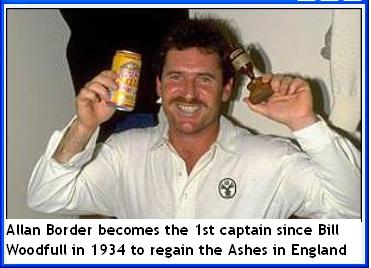
Steve Waugh completely demoralized the English attack in the 1st test and such was the domination he exercised over their bowlers by the time they could pick up his wicket Australia already won the first two test matches and 3rd test was into its 2nd day. Waugh made 393 runs including 177* in the 1st Test at Leeds, 152*& 21* in the 2nd test at Lord’s and 43 in the 3rd test Edgbaston before getting clean bowled by Angus Fraser. In that rain ruined drawn encounter Dean Jones helped himself with a century and made 157. The 4th test at Old Trafford was the only test of the series in which no Australian batsman could hit a century, but both Lawson and Alderman made amends for their batsmen’s time-out by bowling out England under 300 in both innings and secured a 9 wicket win for their team to make their captain first captain since Bill Woodfull in 1934 to regain the Ashes in England.

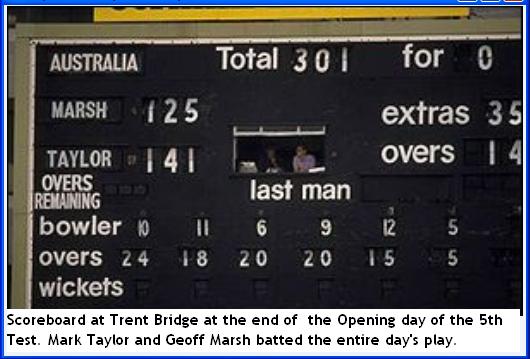
Mark Taylor made 839 runs in the series with 2 hundreds and 5 fifties. He hit a fifty in every test match. His opening partner Geoff Marsh too had a good series though not as stellar as Taylor did. Marsh’s century came in the 5th test at Trent Bridge when both Marsh & Taylor rubbed the struggling England’s wounds with more salt by batting the entire first day. Taylor made a glorious 219 to compensate for Steve Waugh’s duck and Australia won the test by an innings and 180 runs. Bad Weather during the 6th test at The Oval deprived another victory for Australia. But the way they took upon England created a whole new generation of Aussie cricketers who till today kept their dominance in all forms of the game.

Ashes Countdown Factoid 96:

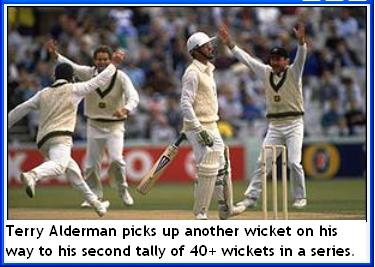
It was not just Australia’s batmen that dominated the series, their bowlers too gave their best spearheaded by Terry Alderman who took 41 wickets in the series and still remains the only bowler to have taken 40+ wickets in a test series on two separte occasions. Lawson with 29 wickets, Merv Hughes with 19 and Trevor Hons with 11 were the other destroyers of the feeble English batting line-up.

The 1989 Ashes Series was a career defining series for most of the Australian players, but for 9 of the 29 players that England tried during the series it proved out to be a career ending series. KJ Barnett, Chris Broad, Nick Cook, Tim Curtis, Graham Dilley, MD Moxon, and RT Robinson. JP Stephenson & Chris Tavare never played test cricket after this series. Careers of many other English cricketers did not go too far after this series. Ian Botham played just 5 more tests, David Capel 4 more, John Emburey 4, Neil Foster 1, Mike Gatting 9, Gower 11, Hemmings 7, Igglesden 2, Newport 1 and Gladstone Small 11 after the 1989 Ashes. Their only blessing in disguise was Michael Atherton, who made his test debut in the 5th Test and went onto play 113 more tests after this series. For England the lone batting mainstay was Robin Smith who made 553 runs with 2 hundreds and 4 fifties.

For Australia, Trevor Hohns was the only player who never got a chance to play in test cricket again after this series though he played in all of the last five tests as part of the same playing eleven. Trevor Hohns, a decent leg spinner and a shrewd cricketing brain, later went on to become the Australia’s Selection Committee Chairman.

When Trevor Hohns replaced Greg Campbell for the 2nd test of the series he did not know that he is taking the position of a player whose nephew would become a key member of an Australian side who would win 16 tests in a row and win the world cup for Australia during his tenure as chairman of the Australian Selection Committee.

Can you guess?

No it’s not Steve Waugh. It’s Ricky Thomas Ponting, who last year returned back the Ashes that were won 1989 to England in one of the most thrilling test series ever. No doubt he would like to regain the Ashes back in this winter. With the kind of form he and Australia is in right now I don’t bet against it.

Friday, August 18, 2006

Ashes Countdown 97

As mentioned in my previous Ashes Countdown posting (#98) the disastrous tour of Australia by England which resulted in a 5-0 drubbing for the visitors was the first test series played after the World War I. England failed to reach the pre-war standards as they hardly played any competitive cricket during the war whereas Australia continued playing their domestic cricket competions. If that was one factor, age may have been another.

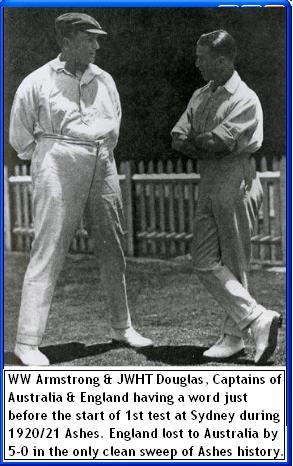
England had just three cricketers in their touring squad who were in their twenties (Abe Waddington 27, PG Fender 28 & JW Hearne 29). Three members were in their 40s (Wilfred Rhodes 43, ER Wilson 41 & H Strudwick 40) and along with many other players including their captain Johnny Douglas who were so old that they would have retired or at least would have been contemplating on retirement in today’s test cricket. Australia took advantage of England’s lethargic fielding aided with poor catching to score massively. England tried all 16 members of their touring party in an effort to alter the result but all in vain.

One might have expected just a couple of cricketers from the pre-war era in this Series considering the 9 year gap since the previous Ashes in 1911/12. But only 9 cricketers from each side made their test debuts in the whole series. Australia played only 3 players from the pre-war times (Armstrong, Kelleway & Bardsley) in all 5 tests whereas England fielded 4 (Douglas, Woolley, Hobbs & Rhodes) in every test of the series.

Wilfred Rhodes who is considered as “the greatest all rounder ever to have born” could make just 238 runs and claim just 4 wickets in all the 5 tests he played. Frank Woolley another great all rounder though scored a reasonable 285 runs could take just 9 wickets. The Master batsman Jack Hobbs did deliver the goods that was expected of him by aggregating 505 runs and their captain JWHT (Johnny Won’t Hit Today) Douglas did make an impressive 354 runs proving his detractors wrong. But other star cricketers failed to live up to the expectations especially their bowlers.

For Australia players from pre-war era performed as per their reputation. Armstrong scored 464 runs with 3 centuries, (10 & 4) and took 9 wickets. Kelleway made 330 runs and took 15 wickets. Bardsley made 311 runs.

If England relied on experience, Australia on their new talent. Arthur Mailey, CG McCartney, Herbie Collins, Jack Ryder, JM Gregory , JM Taylor, CE Pellew, have all made their test debut in the first test and contributed towards the clean sweep by Australia. Mailey with 36 wickets and Herbie Collins with 557 run topped the bowling and batting charts whereas Jack Gregory with 442 runs and 23 wickets put up a great all round show.

When both teams travelled together in the same ship on England's return trip to contest for the 1921 Ashes, Australia had just 3 new faces in their touring party: Stork Hendry, Edgar Mayne & Tommy Andrews who did not play in 1920/21 Ashes in Australia. It would have been just two had Charles Kelleway did not make himself unavailable at the last minute and was replaced by Stork Hendry.

Getting on to their home turf and conditions they are accustomed to, England thought they would regain the Ashes with ease especially having the luxury of picking up any in-form player they wanted to unlike in 1920/21 Ashes where their selection was limited to just 16. Also with the county cricket coming back into the limelight all the English fans were anticipating a similar margin of victory in the 1921 Ashes for England.

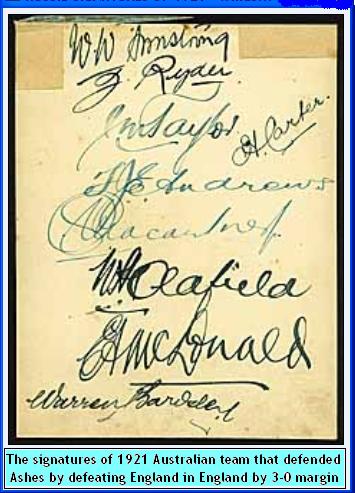
But then... in spite of trying a record number of 30 players in the 5 test series, England continued its misery by getting thrashed by Australia again in the first 3 tests by margins of 10 wickets, 8 wickets & 219 runs and failed to regain the Ashes. Lord Tennyson replaced Johnny Douglas as the captain of the troubling English side in the 3rd test but that did not stop them from losing the match and thereby Ashes. English Cricketing authorities took some solace in the fact that they could at least salvage some prestige by drawing the 4th test at Old Trafford and 5th at The Oval under Tennyson’s captaincy there by avoiding another clean sweep by Australia.

Ashes Countdown Factoid 97:

In a test series where one side wins by 5-0 margin you might think they must be fielding the same eleven in all tests. But Australia played 14 players in 1920/21 Ashes . That record of playing same eleven in every test of an Ashes series is still being held by Alfred Shaw led English touring team of 1884/85 which won the Ashes by 3-2 margin. Only two other teams have played the same eleven in every test of a 5 test series in the history of cricket. South Africa against England in 1905/06 and West Indies against Australia in 1990/91.

The 30 players that England tried in the subsequent 1921 Ashes which they lost by 3-0 margin still remains as a record for most number of players getting capped in any test series. England did come very close to beating their own record in 1989 Ashes when England led by David Gower tried 29 players against Alan Border’s Aussies in a 6 test series which they lost by a margin of 4-0.

Thursday, August 17, 2006

Ashes Countdown 98

As mentioned in my previous Ashes Countdown posting (#99) England did avoid a clean sweep by Australia in an Ashes Series by making ACB to consider the 1979/80 test series outside of the Ashes contest. But England still holds the record of being the only team to have lost every test match in an Ashes series or is it Australia which holds the record of doing a clean sweep in an Ashes series?

The 1920/21 Australians led by Warwick Armstrong have achieved something unique that even the Bradman’s 1948 “invincibles” could not emulate. The series which was lost by England by 5-0 margin still remains as the only whitewash in 124 years of Ashes history.


Winning 5 tests in a series is so rare in test cricket that it occurred only 10 times in 157 Test series of 5 tests are more. 17 of those test series consisted of 6 tests and only twice the results yielded 5 wins in favor of one team. One of them was the 1978/79 Ashes in which England won the series by 5-1 margin. It took almost 68 years for them to register 5 victories in an Ashes though they played against a much weaker team and one test more than the 1920/21 Australians. So we can not find fault with English cricketing authorities to keep the series out of Ashes contention when they were invited to play that short 3 test series to end the WSC crisis.


So we can not find fault with English cricketing authorities to keep the series out of Ashes contention when they were invited to play that short 3 test series in 1979/90 to end the WSC crisis against a star studded Australian side, which was expected to win by 3-0 margin. After all they were in possession of Ashes for less than an year and did not want to give it back so quickly especially knowing that only a miracle can save them from getting defeated.

The 1920/21 tour of Australia by England was the first ever official cricket tour by any country after a 7 year long hiatus in test cricket caused by World War I. The MCC team was captained by JWHT Douglas and had stalwarts like Jack Hobbs, Frank Woolley, Wilfred Rhodes, Patsy Hendren, Jack Russell and Percy Fender in their ranks. They started the tour with four consecutive innings victories over Australian state sides and out played an Australian XI side in a drawn encounter just before the first test of the series.

But in the test series it was a complete reversal of fortunes for England as they lost Ashes, which they won just before the war during the 1911/12 series and kept them for 9 yrs with the intervention of the war, by getting crushed by Australia in the first three tests by huge margins. 1st test at Sydney by 377 runs, 2nd at Melbourne by an innings and 91 runs , 3rd at Adelaide by 119 runs. After losing three tests in a row England’s morale was somewhat got boosted by a convincing 7 wicket victory over Victoria at Melbourne in which Patsy Hendren hit an impeccable 271 and Johnny Douglas hit an unbeaten 133. But their win did not scare Australia as they went on to win the 4th test at the same venue by 8 wickets.

England drew their next tour match against New South Wales and were hoping to salvage some prestige and avoid a clean sweep by Australia. But their hopes were again shattered by that all-conquering Australian Test side as they recorded another easy victory in the 5th test at Sydney by 9 wickets and registered the first and still the only Ashes series win by a 5-0 margin. England did win their last tour match against South Australia by an innings and 63 runs with their star players Wilfred Rhodes and Jack Russell compiling double hundreds and their skipper chipping in with another unbeaten century. Percy Fender took 12 wickets in the match But it was a little too late they hit their top form and not having to face single player from the Australian sides that played the test series in that South Australian side too may have contributed to their innings victory.


The 5-0 victory margin by Australia in that 1920/21 Ashes Series was not only a first in Ashes but was also a first in test history. Australia over the years went on to register two more clean sweeps in their test history once against South Africa in 1931/32 against South Africa in 1931/32 and once against West Indies in 2000/01 . England too have on test series which they won by 5-0 margin when India toured England 1959. India was at the receiving end when they toured West Indies in 1961/62. West Indies registered two more 5-0 Test series wins in back-to-back series against England in England 1984 and at in West Indies 1985/86.

The only other time a 5 test series was won by a 5-0 margin was by South Africa against West Indies in 1998/99 . These are the only eight instances in cricket history when a 5-0 clean sweep was registered in Test Series.Two other test series did include 5 victories for the same side. Once by Australia against West Indies in 1975/76 Australia against West Indies in 1975/76 and the other time as mentioned earlier in this posting by England in Australia 1978/79 Ashes were decided won by 5-1 margin. But as you might have rightly guessed, they are not clean sweeps.


Ashes Countdown Factoid 98:


Though England lost the 1920/21 Ashes by 5-0 margin they still share the record with Australia for compiling the highest test match aggregate in any completed test match when all 40 wickets have fallen. Their combined total of 1753 (Aus 354 & 582 beat Eng 447 & 370) though achieved in 6 days is very unlikely to be overtaken in this age of 5 day tests.

Will the 2006/07 Test series result in a clean sweep either for Australia or England?

I really doubt, as unlike in 1920/21 Ashes when all the tests were played as timeless tests, today’s test matches are restricted to five days and both teams have too many quality players who can atleast save the matches and play for a draw rather than letting their opponent overpower them by a 5-0 margin.

But then…..you never know…. “Cricket is a game of glorious uncertainties.”

Wednesday, August 16, 2006

Ashes Countdown 99

The first test series that was played between Australia and England in 1882-83, after the 1882 England’s debacle and the The Sporting Life’s obituary which gave birth to the Ashes legend, basically was a contest for the imaginary Ashes. The English fourth estate referred the three test matches tour by England as “ the quest to regain Ashes of English Cricket”. England was led by Hon. Ivo Bligh , who later became Lord Darnley.

Australia, captained by Billy Murdoch, won the 1st test at Melbourne very easily by 9 wickets after enforcing a follow on. England came back with vengeance and won the next test at the same venue by an Innings and 27 runs. England’s Willie Bates putting up an excellent all-round perfromance by making a half century (55) and then claiming 7 wickets in each of Austalia’s two innings including a Hat-trick in the 1st. In the 3rd test of the series played at Sydney, after being set an easy target of 153 runs for victory Australia collapsed to Richard Barlow’s medium pace bowling for 83 there by losing the test by 69 runs. Barlow took 7 for 40. Thus England registered a series victory and regained the imaginary Ashes. That’s exactly where the story of Ashes Urn began.

The English captain, Ivo Bligh, who stayed at the home of one Mr. Fletcher’s family was presented with a velvet bag by Anne Fletcher to keep the imaginary Ashes. Bligh later met some victorian ladies who included his future wife Florence Morphy . They thought the velvet bag alone was not an award enough for the England’s victory over Aussies. Florence and her friends burnt either a bail or a stump and kept the ashes in a silver urn and presented it to Bligh. Bligh handed over the souvneir to the cricketing authorities at Lord’s to be seen by other members. They later returned the urn & the velvet bag back to Bligh. The urn which was supposed to have been kept in the velvet bag remained with Bligh and Florence who got married during Bligh’s next trip to Australia.

No one knew the wherabouts of the urn till 1927, when it resurfaced again with Florence presenting it to MCC after the death of her husband as per his will. The urn and the velvet bag are ever since kept under the safeguard of MCC permanetly in the Long Room at Lord’s in a display cabinet.

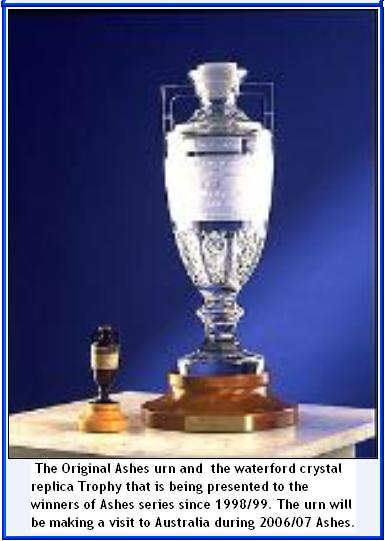
The original Ashes urn was never really handed over to the winning captain and did not move from its display since 1927, except for a brief period during 1988 to be displayed in Australia as part of it’s bicentennial celebrations. So with all the hype that is surrounding Ashes, Australia and England have in fact been fighting hard for an imaginary and virtual trophy for more than 124 years.

As weird as it may sound the goblet shaped 4-inch (10 cm) high urn which was supposed to have made its second appearance in Australia during the Ashes tour of 2002/03 was dropped from the squad at the the last mintue because of an injury to its stem between the main body and the foot. X-Rays revealed that there was a 75 year old crack in that area and as per the advice by the experts there was a real risk of the urn breaking down in that condition when subjected to unnecessary movement and changes in humidity and pressure.

The repair work was carried out by Plowden and Smith Ltd as number of cracks on this most valuable cricketing artifact were fixed with surgical precision. Now the urn is all set to tour Australia during the coming Ashes tour. The urn along with its sibling Velvet bag will be displayed in all five major test cricket centers Sydney, Brisbane, Adelaide, Perth and Melbourne as part of an Ashes exhibition.

Though every test series that were played between Australia and England were cricketing battles to hold the Ashes Urn, no trophy was ever awarded to the winner of the series. Only since 1998/99 Ashes series a Waterford crystal trophy, a much bigger replica of the Ashes urn is being awarded to winner of each of the Ashes test series. England won their first trophy last year when they beat Australia by 2-0 margin in one of the most closely contested and extremely entertaining test series of all-time.

If England keeps the original urn which was bequeathed to MCC by Hon. Ivo Bligh permanently with them Australia does have their own precious 24cm replica which was presented to Bradman after his last test series in England which he led them to a 4-0 series win, though he was out for that famous duck in his final innings he did carry back the Ashes urn replica which is currently showcased in Australian Cricket Board’s offices in Jolimont, Melbourne.

Ashes Countdown Factoid 99:

None of the series played before the 1882/83 were considered as Ashes Tests. This includes the 1882 Test at The Oval which started the legend of Ashes. This could be because the Ashes term came in to vogue only after the test match was played and was lost by England in that manner.

A fourth test match was arranged and played at Sydney after England regained the imaginary Ashes by winning the 1882/83 test series which brought the Ashes urn in to its existence. This test may have been arranged to field a much stronger Australian side to beat England which they eventually did by 4 wickets.

The centenary test played at Melbourne during 1976/77 tour which produced exactly the same result as the first ever test match played at the same venue in 1876/77 (A victory for Australia by 45 runs) is not considered as an Ashes Test so is the centenary test played at Lord’s in England in 1980. Also the 1987-88 Sydney test which was played as part of Australia’s Bi-centenary celebrations is not considered as an Ashes Test.

The only test series during which England played 3 or more tests but still not considered as Ashes series was the 1979-80 test series when Australia played both England and West Indies in tandem. England agreed to play that series as part of a deal between ACB and Kerry Packer to end the World Series Cricket under the condition that those tests did not have Ashes status. After all they were holding the Ashes which they won the previous season by beating a very weak Australian side by 5-1 margin and did not want to take the risk of handing it back as the Australian team now included the likes of Chappell brothers, Rodney Marsh, Doug Walters and the terror twins Lillee & Thomson were expected to thrash England in a clean sweep. Their fears were found true as England lost that series by 3-0 margin.

Tuesday, August 15, 2006

Ashes Countdown 100


Its exactly 100 days from today England and Australia would be starting their quest for the Ashes. England tries to keep the urn which they deservedly won last year and Australia which had kept it for 16 years, will attempt to regain it back. Number 16 seems to be an unlucky one for Australia as they lost that famous Laxman’s Test to India after winning 16 tests in a row. Anyway that is beside the point.

Earlier in the morning at Sydney Harbor Michael Clarke & Brett Lee cut a cake shaped in the form of the Ashes Urn to mark the countdown.

Starting today I would like to present some interesting facts about the Ashes during the next hundred days (not every day) leading upto the first day of the first test to keep myself occupied,excited and prepared for the big event that’s going to start at Brisbane on Nov 23rd 2006. Here we go:

Ashes Countdown Factoid 100:

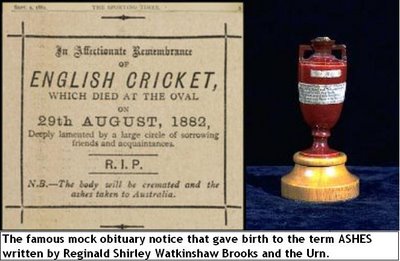
It’s a well known fact that The Sporting Times has published the following mock obituary on September 2nd 1882 which led to the creation of the term Ashes for the series between Australia and England ever since.

"In Affectionate Remembrance of ENGLISH CRICKET, which died at the Oval on 29th AUGUST, 1882, Deeply lamented by a large circle of sorrowing friends and acquaintances R.I.P.
N.B. — The body will be cremated and the ashes taken to Australia."


Here are some of the lesser know facts.

Not many people know who wrote that : His name is Reginald Brooks.

Similarily not many people know there was similar mock obituary which was published couple of days earlier in the 31st August edition of a Cricket magazine “Cricket: A Weekly Record of The Game” Which read “English Supremacy in the Cricket Field which expired on the 29th day of August at the Oval”. I doubt if this too, in addition to the 7 run loss that England suffered while chasing a paltry 85 run target, has had any influence on the young London Journalist “Reginald Shirley Watkinshaw Brooks” to come up with the now immortalised Ashes obituary notice.

The poem that appears on the urn which is believed to contain the the ashes of the burnt bails or stumps or may be none of them reads as follows:

When Ivo goes back with the urn, the urn;
Studds, Steel, Read and Tylecote return, return;
The welkin will ring loud,
The great crowd will feel proud,
Seeing Barlow and Bates with the urn, the urn;
And the rest coming home with the urn.

We can only assume that the poem, which was presented to Bligh along with the urn, may very well have been written by Florence, wife of Hon. Ivo Bligh's who lead the 1882-83 English team that toured Australia.

Friday, August 11, 2006

Test Records - Week Ending 6th August 2006

As it is becoming increasingly time consuming to insert tables with hyperlinks from my spreadsheets onto this blogger, I have alternatively having my blog posted at http://vjeedigunta.sulekha.com and http://cricketstats.rediffiland.com.

Please visit those sites for the tables/lists with hyperlinks to the players/test matches. However, I will be having a static picture of the tables for your referece to the stats.

Test # 1812 South Africa in Sri Lanka 2006 (2nd Test) at P Saravanamuttu Stadium, Colombo


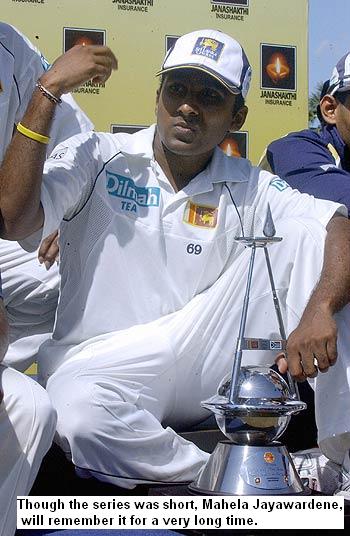
Rarely in Test History a short 2-test series will produce so many records as the series between Sri Lanka and SA did. The second test too lived up to the expectations of all cricketing buffs who were anticipating more excitement in the series after the records-setting first test. With a masterly knock of 129 following his marathon innings of 374, Jayawardene not only took his aggregate past 500 mark but also helped Sri Lanka register a 2-0 series victory. In the end the test match proved out to be a real thriller and provided all the excitement, drama and suspense of an Hitchcock movie to everyone who watched it except for a former Aussie batsman and commentator Dean Jones for obvious reasons.
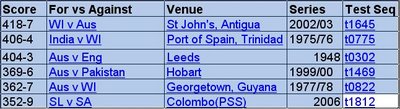
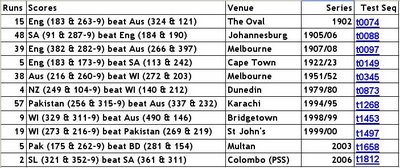
The test match could have produced all the four results and it’s a tribute to Sri Lanka that they won the test match at the end without choking like they did against the same rivals at Asgiriya stadium , Kandy in 2000 (t1505) when they fell short by 8 runs chasing a modest victory target of 176 and were 161 for 6 before losing their last 4 wickets for 8 runs.

Four years later at the same venue in 2004 (t1688) playing against Australia, Sri Lanka was chasing exactly the same score of 352 as in this test. They were crusing along comfortably at 319 for 7 at one stage needing just 33 more runs for victory. Sri Lanka started the final day at 301 for 7 and were inching towards victory with their 8th wicket pair Vaas(30*) & Lokuarachchi(13*). They needed to score just 51 more runs on the final day and were doing well to take the score to 318 for 7 before a sudden rush of blood made Chaminda Vaas threw his wicket away by trying to slog sweep a Warne’s delivery and was out getting caught in the deep. That triggered a Sri Lankan collapse as they lost their last 3 wickets for 5 runs and fell short of the target by just 11 runs.

Memories of those two test matches may have been lingering through the minds of five members of the current Sri Lankan squad ( Jayasuriya, Sangakkara, Mahela Jayawardene Vaas & Muralitharan) who were part of those two losses, when Malinga joined Maharoof with Sri Lanka needing just two runs. But Maharoof and Malinga took a single each to register a dramatic win for Sri Lanka and in this case made sure that history does not repeat itself and they no more a bunch of chokers who would wilter under pressue.

Here are the some statistical highlights of this test:

Sri Lanka’s 352 run chase for a victory is sixth highest in test cricket.
Sri Lanka’s One wicket win is 11th such instance in test cricket and their victory target is highest among these victories.
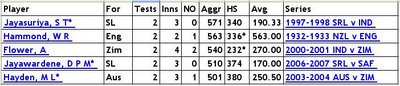
Jayawardene aggregated 500+ runs in this two-test series and joined another four cricketers who did the same in test history. Following is the table of all such instances.

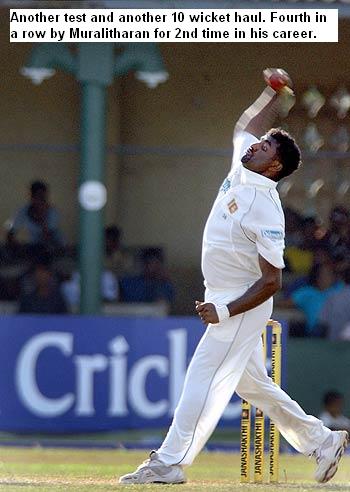
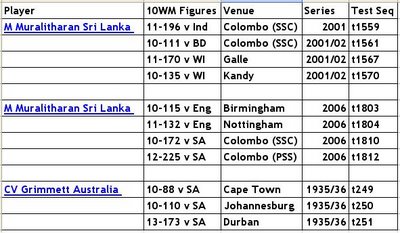
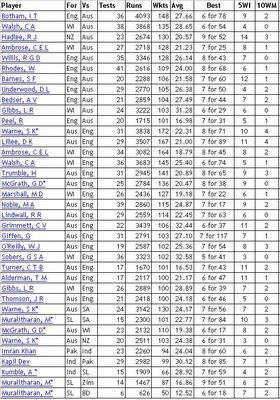
Muralitharan registered another 10-wicket haul, a record 18th time in a test career, thus making it 4-in-row (t1803,t1804,t1810 & t1812). This is the second time that he achieved this remarakable feat having done so earlier in 2001(t1559,t1561,t1567 & t1570). No other bowler could achieve this feat even once. Only bowler who came anywhere near this record was Australia’s Clarrie Grimmet , who in 1935/36 series against SA (t249,t250 & t251) took 10 wickets in each of the 3rd,4th & 5th tests. His feat though was unique in its own way as he is the only bowler in test history to have taken 10 wickets in a test 3 times in the same series. Muralitharan’s with his twin 5-wkt hauls in this match 5 for 128 in 1st innings and 7 for 97 in the 2nd has also extended his 5 wicket in an innings of test match record to 56. Muralitharan at the end of this series has taken his career tally to 657 wickets from 108 tests at an average of 21.89 at phenomenal strike rate of 6.08 wickets per test. He is now just 28 wickets short of Shane Warne's record. Warne has 685 wickets from 140 tests at an average of 25.25 and a strike rate of 4.90. Just for those who are stistically minded like me. Warne has taken 134 tests to take 657 wickets. In 9 tests that Murali played this year he has taken 73 wickets with eight 5-wkt hauls in an innings and seven 10-wkt hauls in match. That is truly amazing.

Following is the list of Murali’s and Grimmett’s 3+ consecutive 10 wicket hauls:


Muralitharan also claimed his 100th test wicket against SA and became only the 2nd bowler in test history after Shane Warne to have claimed 100+ wickets against springboks. In all, there are 32 instances of a bowler claiming 100+ wickets of the same opponent. 11 of them took 100+ wickets against Aus, 17 against Eng, 2 against SA, 1 each against WI & NZ. Kapil Dev missed to become a part of this club by a whisker. His 99 wickets against Pak is highest against that country. Kapil’s counterpart Imran Khan holds the record for most number of wickets against India.with 94 wickets. Anil Kumble with 66 against Sri Lanka and Muralitharan with 87 against Zimbabwe and 50 against Bangladesh holds the records agsinst those countries.

Following is the table of all 100+ wicket-takers against a specific country:

South Africa too had their share of test records in this test. They provided the 102nd instance of amassing 350+ runs on the first day of a test match. (refer to my earlier posting on this). But in a stark contrast to such a good batting display in first innings , they lost both their openers for a duck in the 2nd innings thus providing 42nd occasion of a team losing both their opening batsmen for a duck in an innings.

Nicky Boje who had a torrid time in his previous test when his bowling went for a leatherhunt, picked up his 100th test wicket in this test in the form of Mahela Jayawardane. He thus becomes 139th player and 10th from South Africa to take 100 or more wickets in a test career.Having already completed his 1000 test runs , he also becomes the 4th springbok to join the 1000runs+100wkts all roudners club as its 47th member.

In Sri Lanka’s first innings when Mark Boucher caught Chaminda Vaas off the bowling of Steyn he became only the 2nd Wicket Keeper in test cricket to have taken 350 catches behind the wicket. Boucher’s tally includes 2 catches he had taken while playing for ICC XI against Australia.

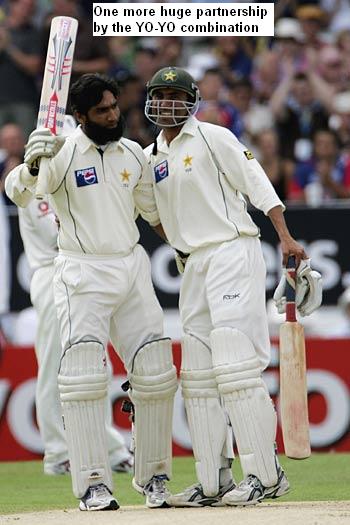
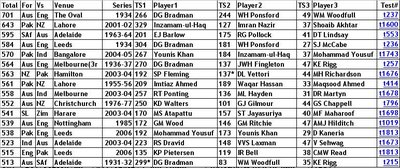
Another rare occurrence that happened in this test match was that in all four innings of the match 300 or more runs were scored. This in fact is only 13th such instance 8th in a test match that produced a result.


Test #1813 England in Pakistan 2006(3rd Test) at Headingley, Leeds


This test match which followed the same course till the final day with Pakistan needing 323 runs for a victory with all their wickets in hand, kind of finished with an anti-climax as Pakistan was bundled out for 155 runs thereby leaving England winners by a huge margin of 167 runs. The Yo-Yo combination (Younis Khan with 173 & Mohammad Yousuf with 192) again produced a huge partnership of 363 runs, but this time in a losing cause. Though their partnership did not help in a victory for Pakistan, it did break a an 81yr old record of 283 run opening stand between Jack Hobbs & Herbert Sutcliffe against Australia in 1924/25 at Melobourne as the highest partnership for any wicket by a losing side.

The 3rd wicket partnership of 363 runs between Younis and Yousuf also set a new partnership record by Pakistan for any wicket against England when they touched the 323 run mark eclipsing the previous best between Javed Miandad and Salim Malik who added 322 at Edgbaston in 1992. When the partnership touched the 339 run mark it became best third-wicket partnership against England, surpassing the previous best of 338 between Everton Weekes and Frank Worrell at Port-of-Spain in 1953-54
With their partnership pakistan amassed 538 runs though no other Pakistani was able to score 30 runs with Danish Kaneria recording the 3rd highest score of 29. Surprisingly this is not a lowest 3rd highest score in a test match innings of 500+ runs. That record still belongs to the 1934 Leeds test in which Australia scored 584 runs in their 1st innings with Bradman making 304 & Ponsford 181 and the next highest score of 27 was being that of Stan McCabe. Following table lists all the test match innings totals of 500 or more in which there were just two 50+ scores. It includes England’s 1st innings too as their 515 total had just two scores of 50+, 135 by Kevin Pietersen and 119 by Ian Bell. This is the one and only such test match occurrence in which both sides scored 500 or more runs with each side having just two 50+ scores.


Both sides making scores of over 500 runs too is a rarity in test cricket.This test match provides 23rd such occasion. This is only the 2nd of those tests which produced a result. Following is the list of all such instances:

Pakistan's loss also provides only the 9th instance of a side making 500+ runs in their 1st innings and still went on to lose the test match. Side batting first is listed first in the table from the left.
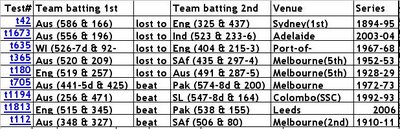
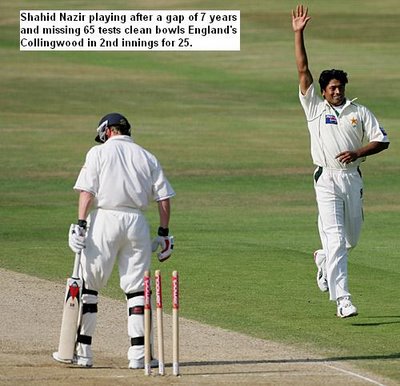
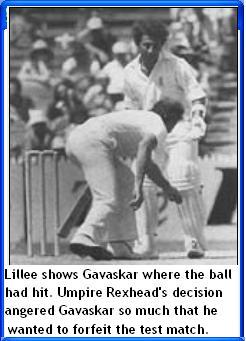
Finally some trivia facts:


By getting out with not so common type of dismissals in both the innings , hit wiciket in 1st and stumped in 2nd , Inzamam-ul-Haq becomes only the 2nd cricketer in history to have got out in both the innings of a test match as stumped and hit wicket. Robert Peel of England was the other batsman to have suffered this fate against Australia at Sydney in 1887-88.


Shahid Nazir of Pakistan made a comeback to test cricket after being in oblivion for more than 7 years and missing 65 tests.The record for missing for most number of tests by a cricketer between two test appearances belongs to Mark Bicknell of England who missed 114 tests from 1993 to 2003.

Danish Kaneria with his 1st innings knock of 29 is fast closing the gap between the number of wickets he has taken in test cricket (167) and the number of runs he made (160).